
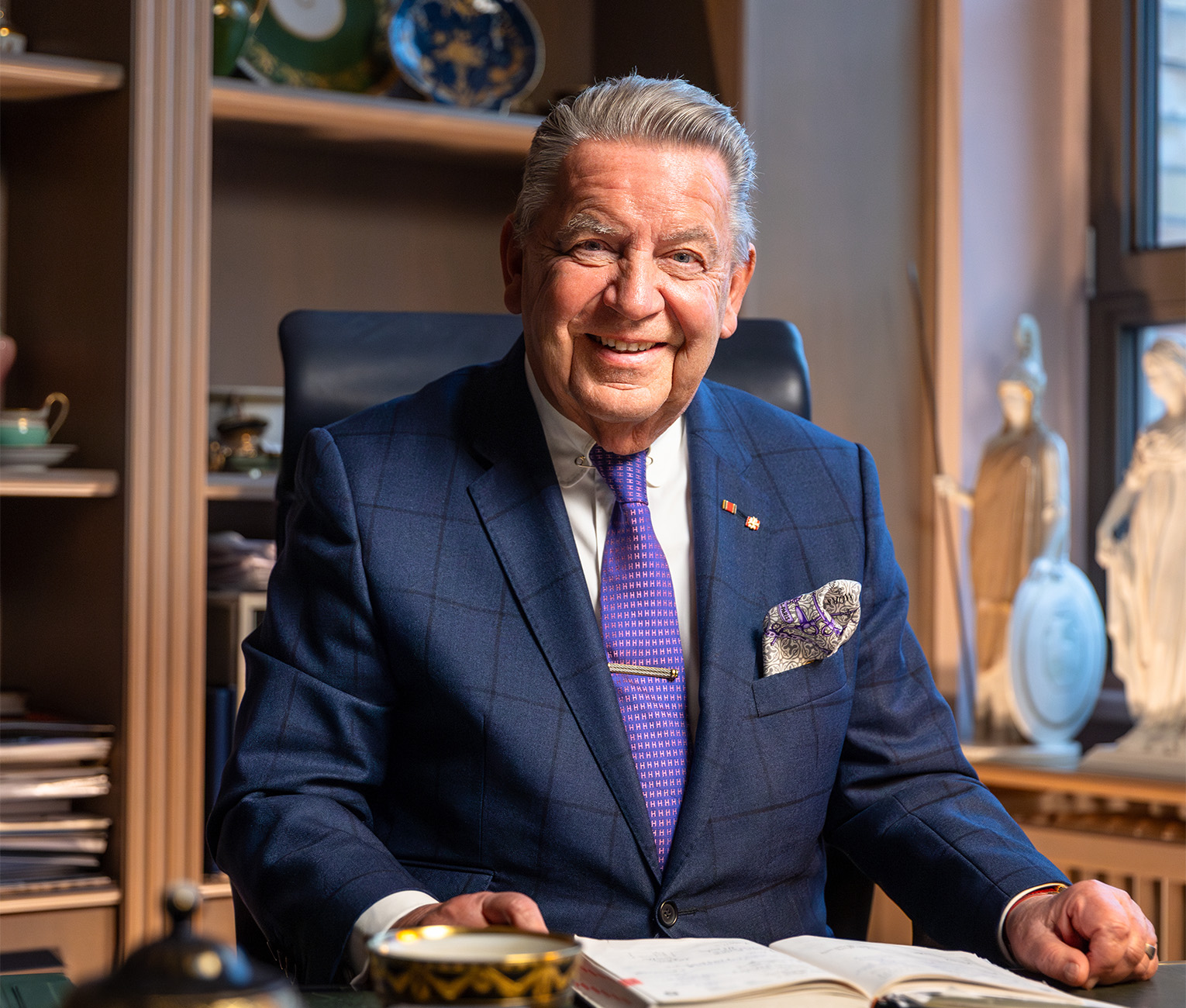
AVIAIR’s editor-in-chief had Woltmann at KPM and was granted a glimpse into the manufactory’s sacred halls. In an exclusive conversation with Sabine Kühlwetter Meiers, Woltmann talks about his personal connection to KPM, the chal lenges of the takeover, spectacular collaborations, and a lost masterpiece that resurfaced after more than a hundred years.
AVIAIR: Thank you for this fascinating tour. You keep an exceptional craft alive at the highest level – from the design of the pieces to their painting and glazing. Before you took over KPM, did you already have a special connection to porcelain?
JÖRG WOLTMANN: Absolutely. I grew up in Berlin, and every Sunday, we ate off KPM tableware. We children knew it was something special because on those days, we weren’t allowed to set the table or do the dishes – that was Grandma’s job. When I sold my first company at 28, I treated myself to three things: a beautiful car, a high-end watch, and a KPM Kurland dinner set for eight.
So, your appreciation for KPM’s craftsmanship goes way back. These are truly exceptional pieces, representing a unique aspect of fine dining culture. Exactly. The relief work, the timeless shapes – KPM has always been a piece of cultur al heritage for me. Take the Kurland service, for example: it was designed in 1790 for Peter von Biron, Duke of Courland. What other company can say that one of its products has remained the most popular for 235 years?
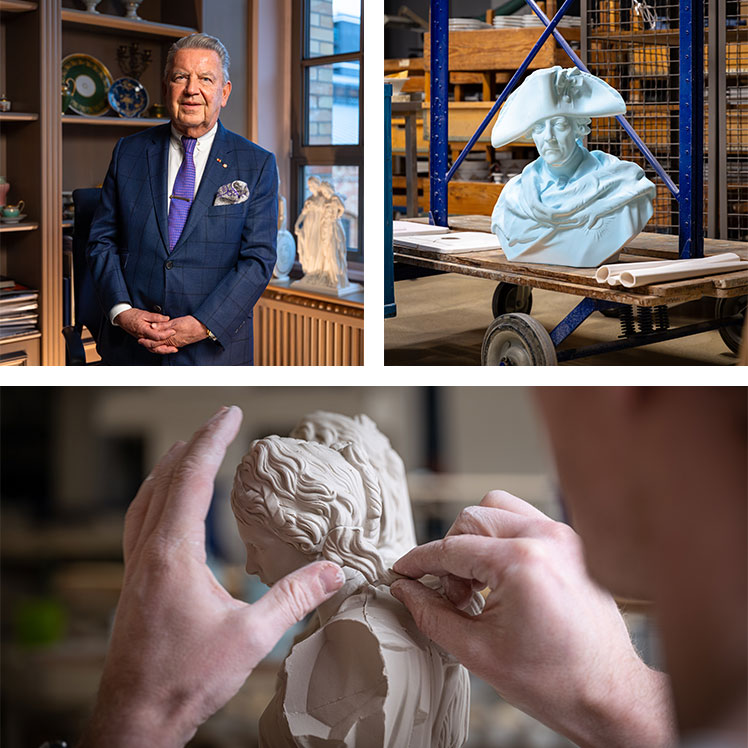
KPM works with centuries-old, iconic designs and stands for craftsmanship passed down through generations. Yet today, the brand feels entirely contemporary. How do you bring such a legacy into the modern era without losing its roots?
The key is seeing tradition not as a limitation but as a foundation. KPM’s history is our greatest asset, but history alone isn’t enough to succeed in the present. We must constantly reinvent ourselves while staying true to our identity. That only works if you remain open – to new ideas, to innovation, and to the people who drive them forward.
What does that mean in concrete terms?
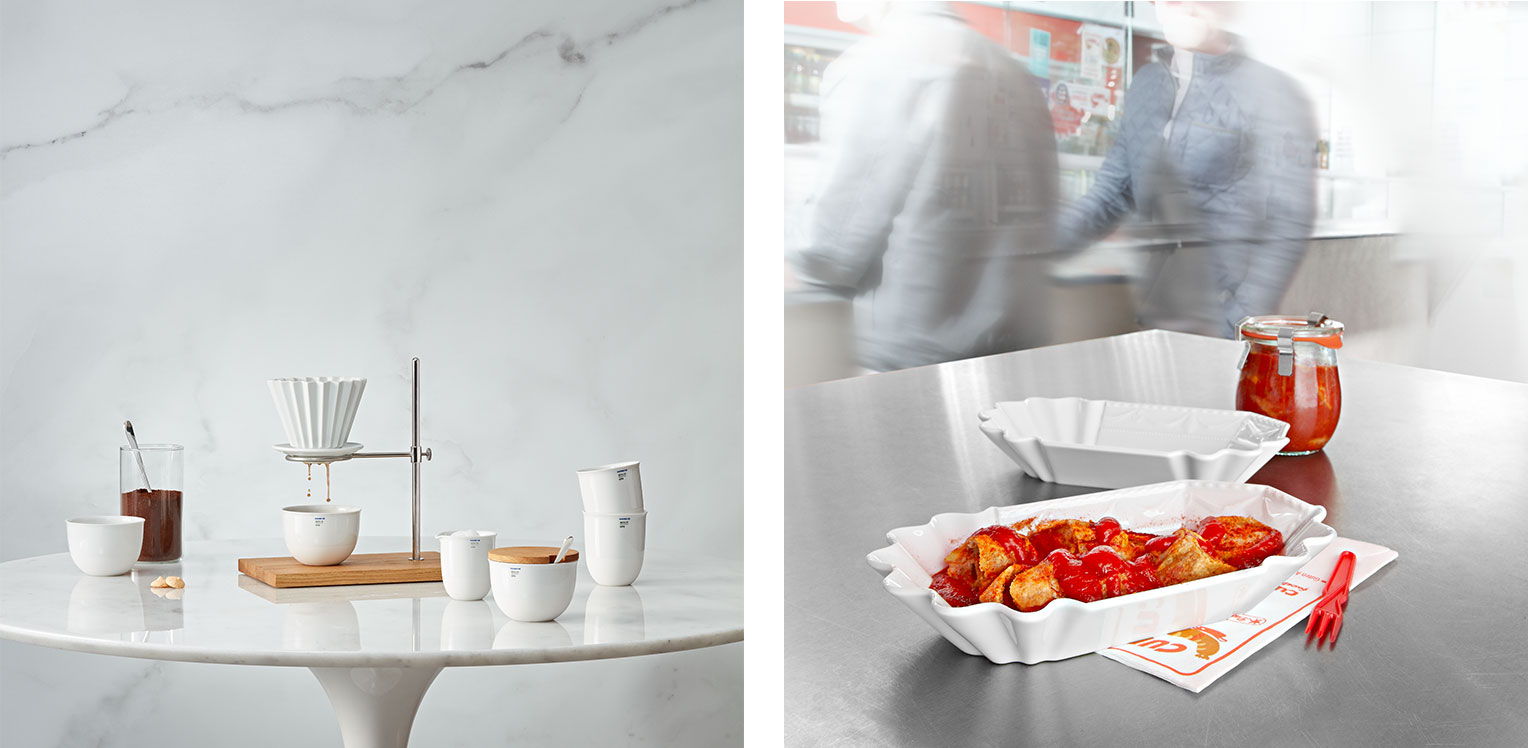
It means, for example, that we don’t just preserve classics like our Kurland service in their original form – we also give them new functions. Our coffee-to-go cup with the classic Kurland relief was one of our first major innovations in this direction. An everyday object, but made of fine porcelain, carrying a history that dates back to the 18th century. It’s the perfect blend of tradition and modernity. The same applies to our Berlin cup or our porcelain Currywurst dish. KPM is not just about luxury – it’s about integrating craftsmanship into daily life while maintaining the highest quality.
Which innovative project has personally fascinated you the most?
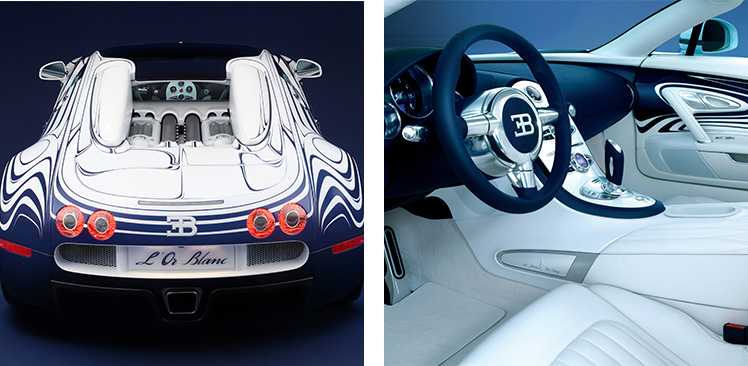
The most exciting collaboration for me was with Bugatti Automobiles. In a very short time, we developed a concept where all the carbon parts of the Bugatti Veyron were recreated in porcelain. It was a technical challenge of the highest level – and, as a car enthusiast, a true passion project.
A Bugatti with porcelain elements – that sounds almost surreal.
It was an incredibly demanding project. The wheel hubs, the fuel cap, the emblems, interior reliefs – all made from KPM porcelain. Every part had to fit with millimeter precision, withstand extreme pressure, and still maintain the elegance expected from KPM. For the Chinese market, we even created a special edition featuring a porcelain dragon.
You juggle many responsibilities – entrepreneur, banker, leader of a prestigious manufactory. How did you get to this point?
I started with a traditional banking apprenticeship and quickly went into business for myself. Even during my studies, I founded my first company. Finance has always fascinated me, but I didn’t want to be just another cog in the machine – I wanted to build something of my own.
So you founded your own bank …
Exactly. I co-founded the Allgemeine Beamtenkasse, a private bank specializing in financial services for civil servants and public employees. The bank became very success ful and opened up many entrepreneurial opportunities for me.



When you took over KPM, the company was in a difficult situation. What was the biggest challenge?
Trust. For years, the employees didn’t know what the future held. Would the manufactory shut down? Was there a future at all? I had to prove that I wasn’t some financial investor looking to restructure and sell – I was here to preserve and grow.
And all employees stayed on?
Not only that – I didn’t lay off a single person, and we even expanded the workforce. My goal was to maintain the substance and create new perspectives for the future. The artists who work here are the heart of the manufactory, and I wanted to give them stability.
You’ve successfully positioned KPM within the luxury segment. What was your most exciting collaboration?
Without a doubt, the partnership with Bugatti. The outcome was spectacular.
And then came the collaboration with Birkenstock …
Exactly. We developed a limited edition: black leather with Kurland gold detailing and a porcelain inlay. All 2,500 pairs sold out within an hour!
I assume there are more projects like this in the pipeline?
Absolutely. KPM is a brand with tradition but also with an innovative spirit. We’ve worked with Bottega Veneta, launched sustainable projects with Vattenfall, and partnered with exclusive restaurants and hotels worldwide to place KPM porcelain in the finest locations.
One of the most incredible stories is the return of a long-lost KPM artwork.
Yes. In 1893, KPM created a monumental porcelain tile mural for the German Pavilion at the Chicago World’s Fair – six meters high, five meters wide, made up of over 1,000 tiles. After the exhibition, it disappeared. For decades, it was considered lost.
And then it was rediscovered.
Exactly! A German professor in Chicago found it in the 2017 – packed away in the attic of a retirement home. At first, he couldn’t believe what he had uncovered. Upon closer inspection, it became clear: the mural was still largely intact, though in poor condition.
Restoring something like that must have been an enormous effort.
It was a lengthy process that took about two years. The central image was completed in September 2024, and the side panels are still being restored. We even created a dedicated exhibition space to make the artwork accessible to the public.
Where do you see KPM in ten years?
I’ve established a foundation to preserve this cultural heritage. My goal is to secure KPM for Berlin and for Germany while continuing to grow internationally.
That sounds like a long-term vision.
KPM is a bridge between the past and the future, and I want to ensure it stays that way.
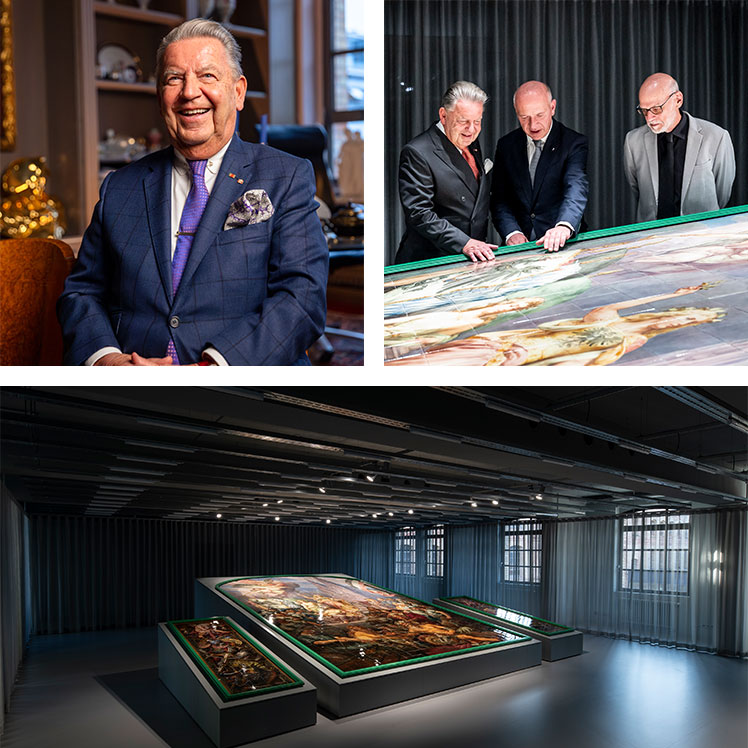
LOST, FOUND, RESTORED – GERMANIA RETURNS HOME
Long believed to be lost, it now shines in new splendor: Germania – Protector of Art and Science. The monumental porcelain tile mural, created by the Royal Porcelain Manufactory Berlin (KPM) for the 1893 World’s Fair in Chicago, has made its way back to Berlin after a spectacular rediscovery and extensive restoration. From spring 2025, it will be open to the public.
The artwork depicts Germania as the guardian of science and art, symbolizing the cultural and intellectual strength of the German Empire. Its creator, Alexander Kips, received the highest accolades for this masterpiece, composed of 1,057 intricately painted porcelain tiles. But after the exhibition, the artwork vanished – until 2017, when Germanist Professor Reinhard Andress, after years of meticulous research, uncovered it in a dusty attic in Chicago, packed away in 23 forgotten crates.
The KPM Foundation took on the restoration, supported by conservator Anne Göbel and a team of porcelain painters and art experts. To ensure the artwork’s long-term preservation, a sponsorship program was established: for €500, supporters can symbolically adopt a single tile.
With Germania’s return, not only does a significant piece of art history find its place in Berlin, but it also invites reflection on a fascinating chapter of German-American cultural heritage.