
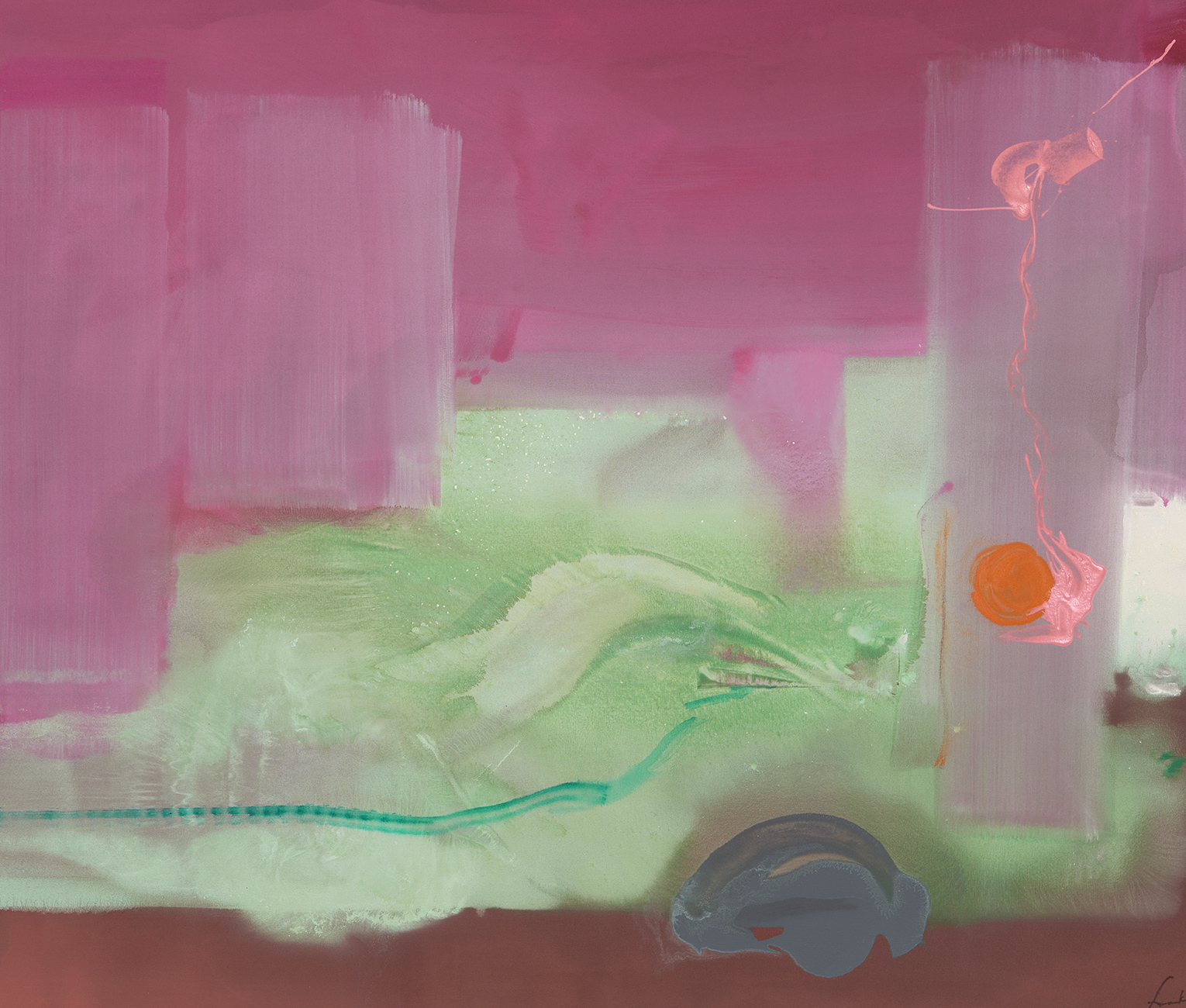
In a male-dominated art self as an independent voice and played a key role in the evolution of abstract painting. But her art was not only a personal act of emancipation in a field where women were often sidelined – it also signified a liberation of painting itself.
Frankenthaler freed color from form, redefined the relationship between canvas and pigment, and opened up new artistic territory.
Frankenthaler articulated her drive for renewal and her creative ethos in the early 1970s with a statement that encapsulates the essence of the Move and Make exhibition at the Museum Reinhard Ernst (mre) in Wiesbaden. “I’d rather think and move and make than halt.” Her recognition today as a bridge between Action Painting and Color Field Painting underscores her significance in art history.
Since mid-March, the mre has been hosting a major solo exhibition dedicated to Helen Frankenthaler. We have previously covered this outstanding museum for modern art, which has a particular passion for abstract painting. That Frankenthaler is now at the center of attention here is more than deserved. As a 20th-century artist, she expanded the possibilities of painting and created a visual language that continues to resonate today.
Frankenthaler was born on December 12, 1928, in New York City and grew up in a wealthy, art-loving household. Her father, Alfred Frankenthaler, was a judge on the New York Supreme Court, while her mother, Martha, had German roots.
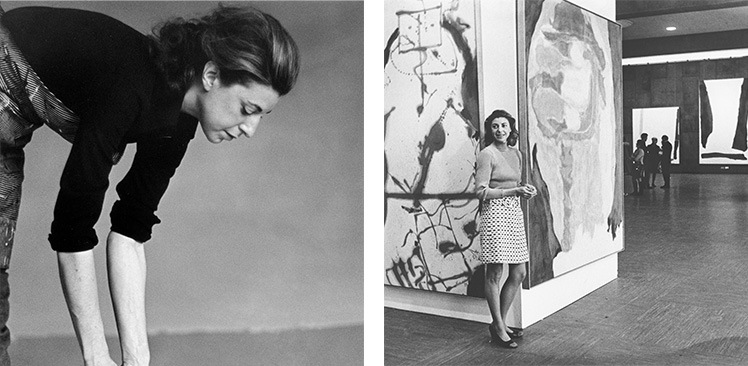
From an early age, her artistic talent was evident, and her parents supported her development. At the Dalton School, she studied under Rufino Tamayo, and later, at the prestigious Bennington College, she was mentored by Paul Feeley. There, she not only honed her artistic instincts but also engaged deeply with modern art.
After graduating, she immersed herself in New York’s vibrant art scene, where she connected with leading figures of Abstract Expressionism.
She was particularly fascinated by Jackson Pollock, the artist whose revolutionary drip paintings shattered traditional notions of painting.
Pollock’s unconventional method – pouring and flinging paint onto a canvas laid on the floor – offered Frankenthaler an entirely new perspective on the relationship between process and image. But while Pollock sought the raw expression of the moment, Frankenthaler took a different path. She embraced the idea of direct paint application but allowed the color to seep into the canvas rather than splatter across its surface. Her approach was subtler, more atmospheric, achieving an almost musical harmony between color and space.
In this way, she deliberately distanced herself from the raw energy of Action Painting and defined a new, softer form of abstraction. Her relationship with the influential art critic Clement Greenberg also granted her access to the most prestigious galleries and collections of her time. But Frankenthaler was much more than a talented student or a muse – she was a pioneer with a distinct artistic vision.
THE INVENTION OF A NEW VISUAL LANGUAGE
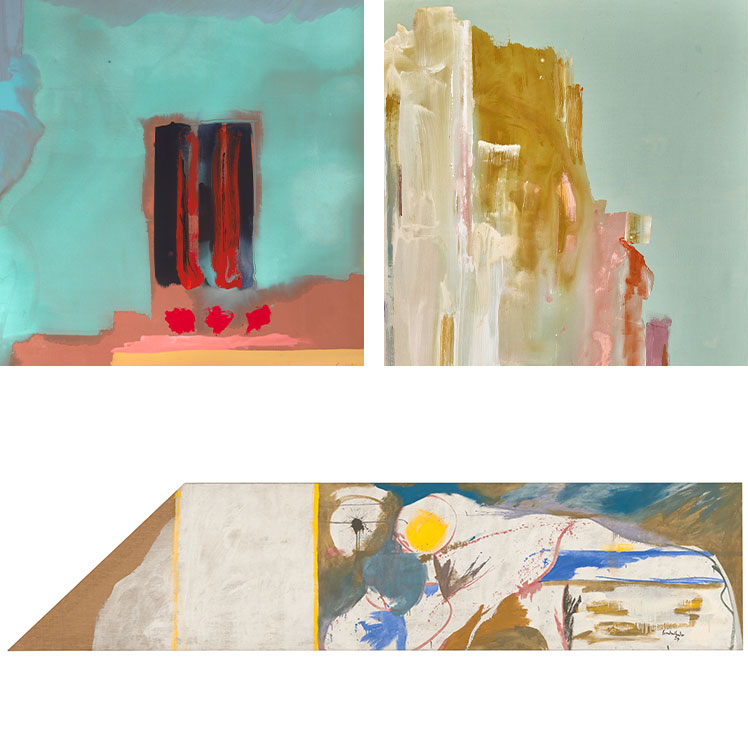
In 1952, she created her first tains and Sea. Instead of using a brush, she allowed diluted oil paint to soak directly into the unprimed canvas. This technique, later known as soak-stain, enabled an unprecedented, almost immaterial effect of color.
The pigments seemed to emerge organically from the canvas rather than being imposed through gestural brushstrokes. This piece inspired artists like Morris Louis and Kenneth Noland, laying the foundation for Color Field Painting.
Frankenthaler’s work balanced spontaneity and control, creating new pictorial spaces that were not defined by lines or shapes but by gradients and transparency. She liberated color from the burden of narrative or form, allowing it to function as an independent expressive force. Her painting was a dialogue between intuition and reflection, between fluidity and compositional tension. It was a conscious act of freeing painting from the constraints of classical composition. By detaching color from formal structure, she introduced a new kind of fluidity – a revolution that redefined painting’s relationship with form and space.
In the decades that followed, Frankenthaler experimented with various techniques and materials. In the 1960s, she turned to acrylics, which offered even greater possibilities for color modulation. At the same time, she became increasingly involved in printmaking, particularly woodcuts. Once again, she proved her innovative strength: her woodcuts often resembled paintings, achieving a rare level of transparency and color depth.
During the 1970s and 1980s, Frankenthaler taught at prestigious institutions like Yale University and received numerous major art awards. Her work was exhibited in leading museums worldwide, including the Museum of Modern Art in New York and the National Gallery of Art in Washington, D.C. Despite her success, she remained an artist of restless curiosity, never settling into a single style or technique. “I prefer to think, move, and make rather than stand still,” she once said – a statement that perfectly encapsulates her artistic philosophy.


"MOVE AND MAKE" – A POSTHUMOUS TRIBUTE
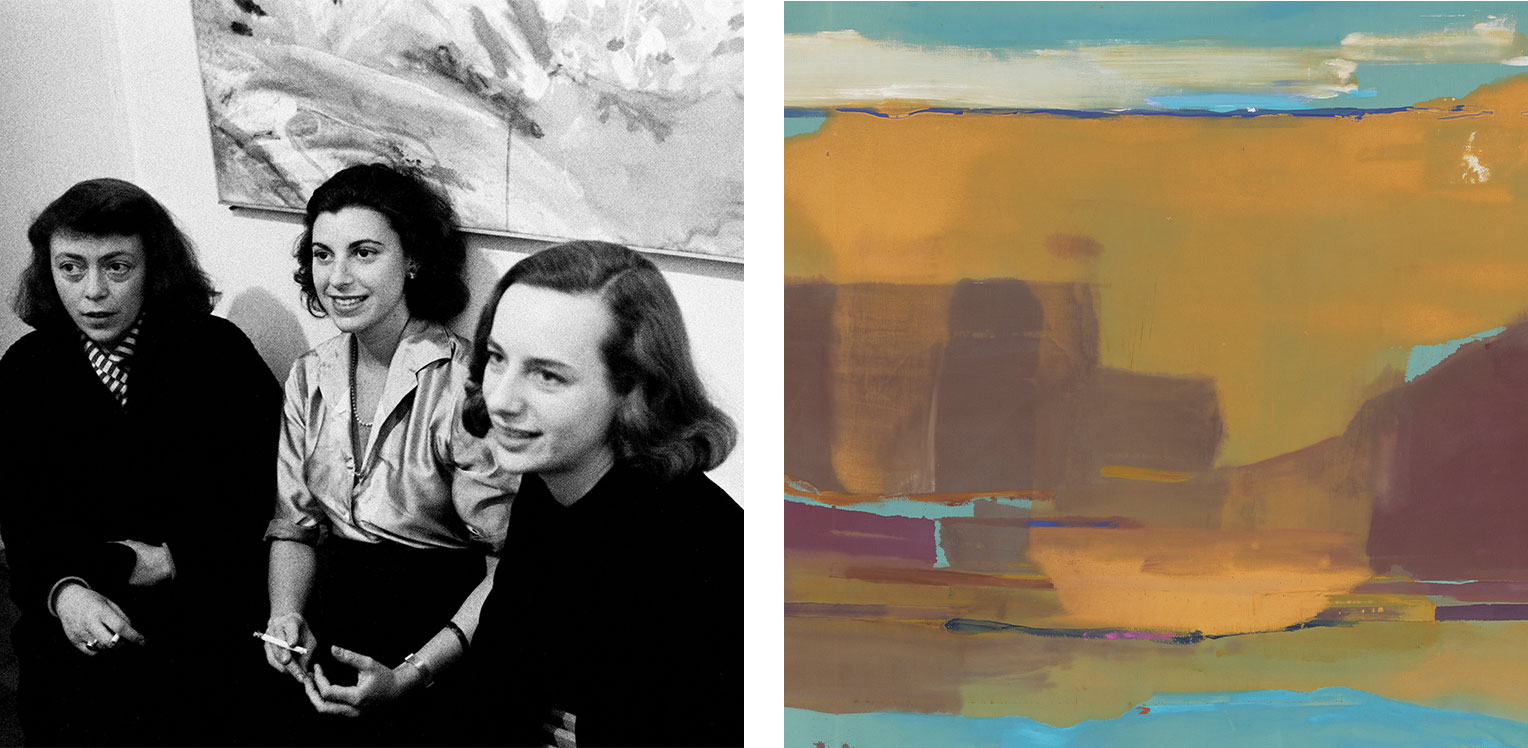
Frankenthaler’s legacy remains as vibrant as ever, as demonstrated by the exhibition Helen Frankenthaler: Move and Make at the Museum Reinhard Ernst. Running until the end of September 2025, this retrospective brings together works spanning four decades, documenting her relentless spirit of innovation. For the first time, the remark able breadth of Frankenthaler’s work from the Reinhard Ernst Collection is presented in a major solo exhibition.
The show highlights how consistently Frankenthaler pursued her artistic vision and how profoundly her work transformed painting. From her early soak-stain compositions to her later, large-scale acrylic paintings, the exhibition reveals a continuous evolution and a deep dedication to art. Particularly striking is the section devoted to her prints, which confirms that Frankenthaler was not only a groundbreaking painter but also a master of printmaking.
Helen Frankenthaler remains a key figure in modern art. Her influence extends far beyond her own era – many contemporary artists draw inspiration from her innovative techniques and unparalleled sense of color. Her works are not just aesthetic masterpieces but also a testament to the transformative power of art. They break boundaries, open new perspectives, and invite the viewer to immerse themselves in the depth of color.
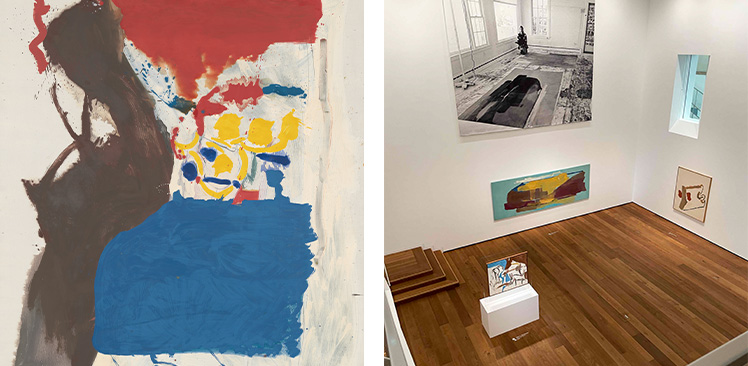
With Move and Make, her work receives a renewed tribute, underscoring the significance of her contributions to art history. Her painting remains a shining example of how art can alter perception and convey emotion in an unparalleled way.
While studying Frankenthaler’s work, it became clear that we must also turn our attention to another towering figure of the New York avant-garde: Willem de Kooning. Though Frankenthaler and de Kooning were not closely connected personally, they worked within the same artistic milieu, shaping and influencing the evolution of abstract painting in their own ways.
Frankenthaler, who established herself in the 1950s within the circles of de Kooning, Pollock, and Rothko, developed her groundbreaking soak-stain technique – a method that revolutionized the relationship between color and canvas. While de Kooning channeled raw energy into expressive brushstrokes, Frankenthaler allowed color to seep into the canvas, creating a new sense of transparency and weightlessness.