
His influence extends Expressionism: he made the canvas tremble, deconstructed and reassembled the human figure, and continuously reinvented himself as an artist.
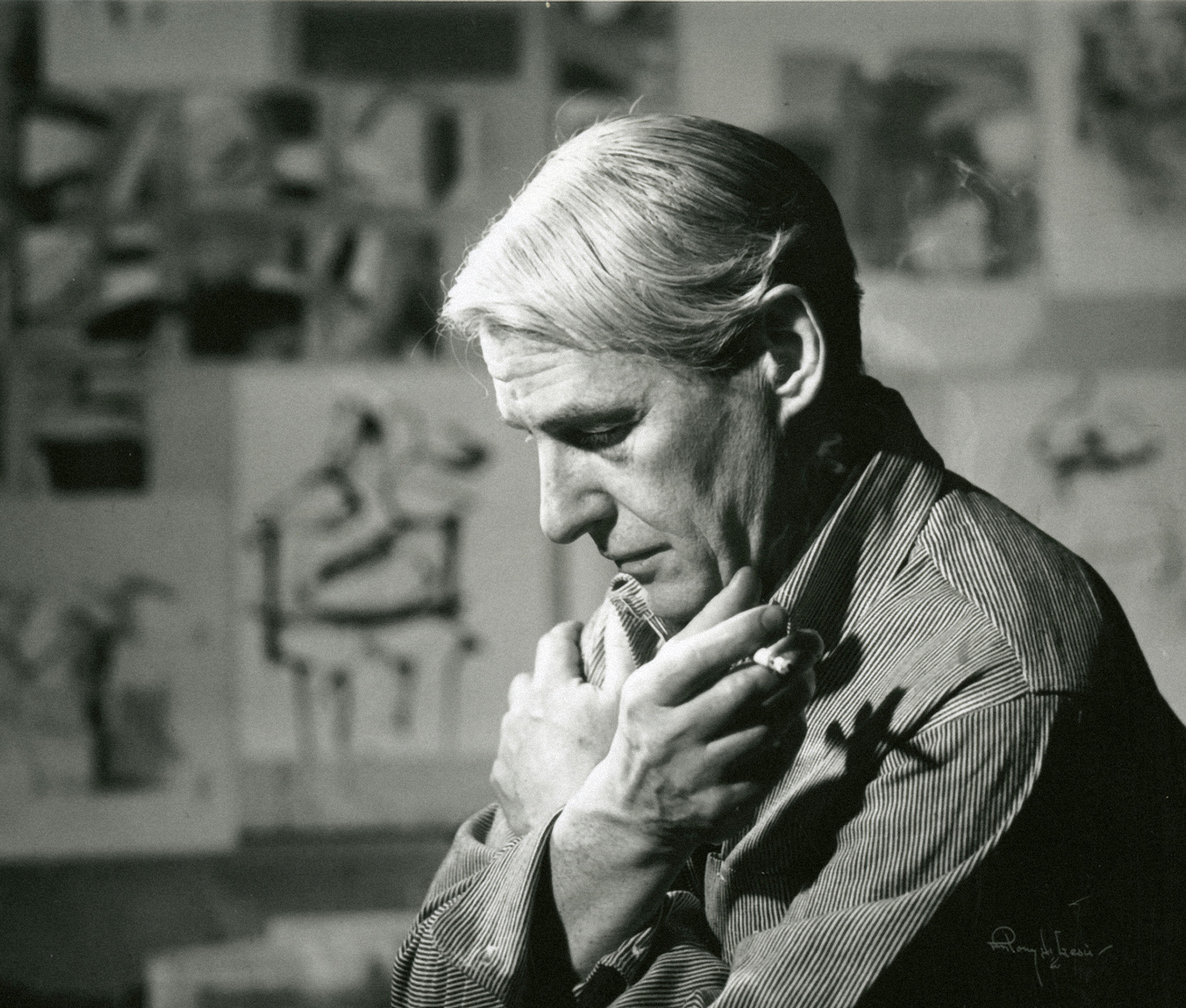
At a time when American art was breaking away from European traditions, de Kooning became one of its most powerful protagonists. Born in Rotterdam, Willem de Kooning grew up in challenging circumstances. His tumultuous relationship with his mother would later leave its mark on his work, particularly his iconic Woman paintings.
His artistic talent was evident early on, and a formal apprenticeship in decorative arts introduced him to design and craftsmanship. But Europe felt too confining for him. In 1926, he smuggled himself aboard a freight ship bound for the United States – without papers, but with an unshakable belief in his talent.
In New York, he initially survived through manual labor before establishing himself as a painter.
Pivotal encounters with Arshile Gorky and Jackson Pollock sharpened his artistic vision. Gorky became a mentor and close friend, while Pollock was both a rival and a source of inspiration. Within the Club of the New York School, de Kooning developed his vigorous visual language – a style that fluctuated between figuration and abstraction, always in motion.
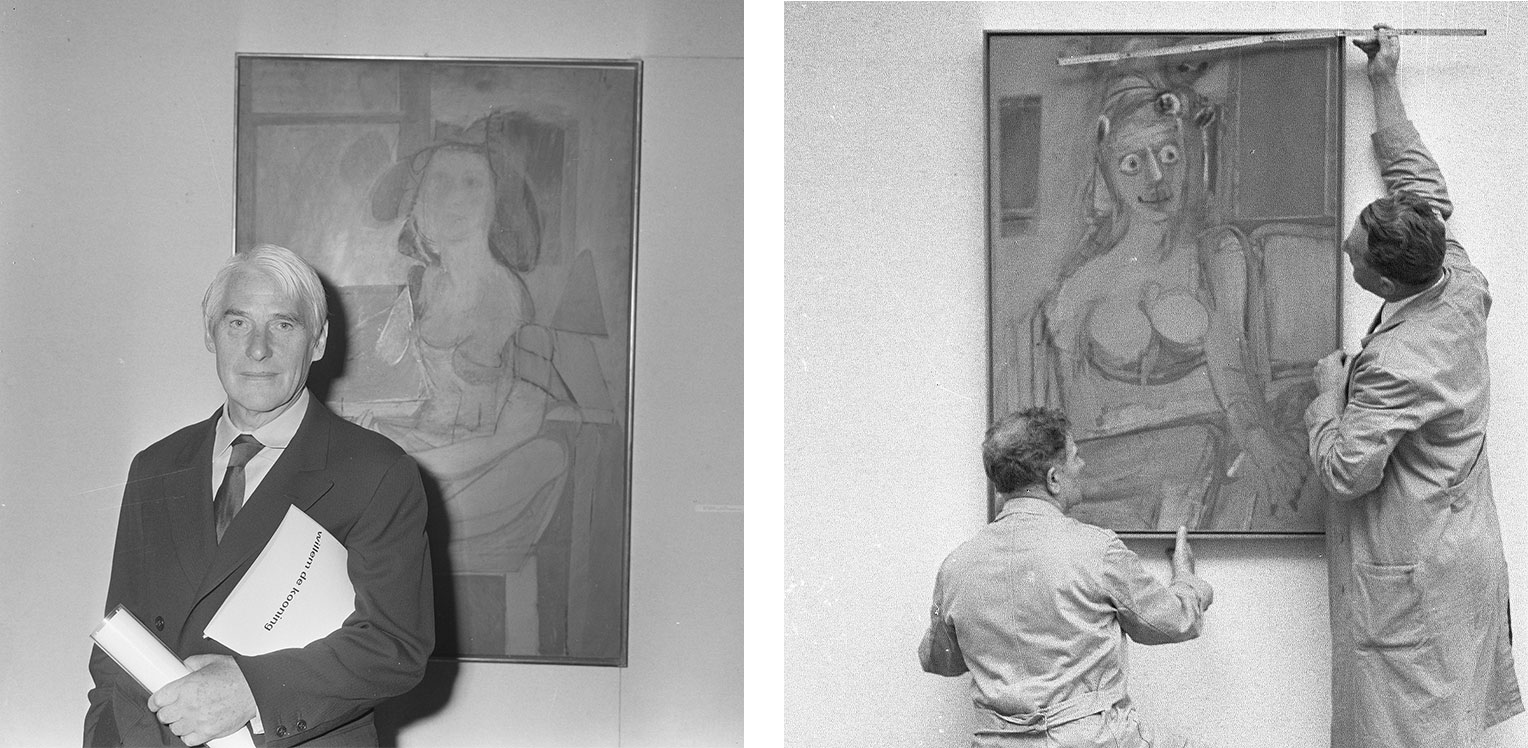
When de Kooning began his Woman series in the early 1950s, he shocked the art world. With wild, slashing brushstrokes, he tore apart classical representations of femininity, transforming Venus and Madonna into archety pal figures of unsettling presence. With raw color, aggressive distortions, and fractured contours, he created a visual language that not only broke with tradition but also defied the conventions of abstraction. He demonstrated that the human figure did not have to be abandoned to be radical. Woman I, now housed at MoMA, was deemed ugly and brutal by many – but it set a new standard for expressive painting.
ACTION PAINTING: PAINTING AS PHYSICAL ACT
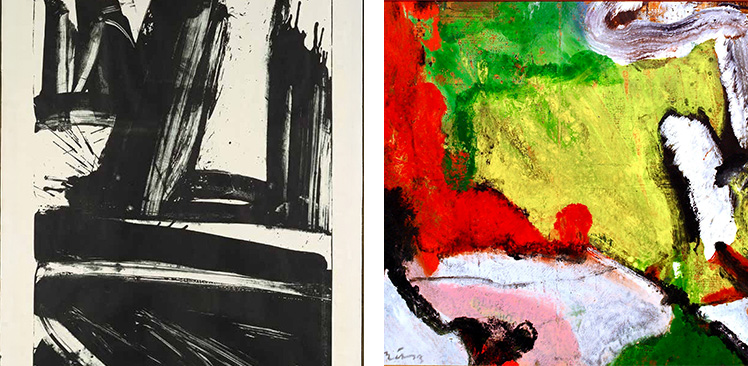
De Kooning is often associated with Action Painting, a movement within Abstract Expressionism that gained international recognition through Jackson Pollock. Coined by art critic Harold Rosenberg in the 1950s, the term describes a form of painting where the act of creation itself becomes the focus. Paint is not carefully applied but rather thrown, poured, or dripped, turning the painting process into a performance. Unlike Pollock, who fully surrendered to chance in his drip paintings, de Kooning remained committed to gesture – yet he combined it with spatial depth and figurative allusions.


By the late 1950s, de Kooning distanced himself from the intense art scene in New York and retreated to Long Island.
There, he created his famous abstract landscapes – paintings where nature and color merge in a vibrating rhythm. The rough, aggressive compositions of the Woman series evolved into open, shimmering fields of light and movement.
With growing fame came personal crises. Struggles with alcoholism, bouts of excess, and persistent self-doubt shaped his life as much as his artistic breakthroughs. The 1960s and 1970s saw radical shifts in his style – ranging from luminous landscapes to almost minimalist, flattened compositions. His late work from the 1980s surprised critics: his painting became calmer, clearer, almost meditative. Yet even in these seemingly simple compositions, the energy of his early works still pulsed beneath the surface.
In the final years of his life, Alzheimer's disease forced him to put down his brush. He passed away in 1997 at the age of 92 – one of the most influential figures in modern art.
Willem de Kooning’s impact on art is undeniable. His work represents unrestrained freedom, a radical exploration of possibility. He proved that painting does not have to be static – it can be a continuous process of destruction and renewal.
Like Helen Frankenthaler, he was an artist of movement – but while she let color seep gently into the canvas, de Kooning hurled it with unbridled force.
Today, his works are housed in the world’s leading museums. And although he was once seen as a provocateur, his name has long been synonymous with artistic independence. Willem de Kooning remains the great destroyer – and creator – of abstract painting.