
A CENTURY-SPANING COLLECTION
A conversation about history, responsibility, and the future of a family collection
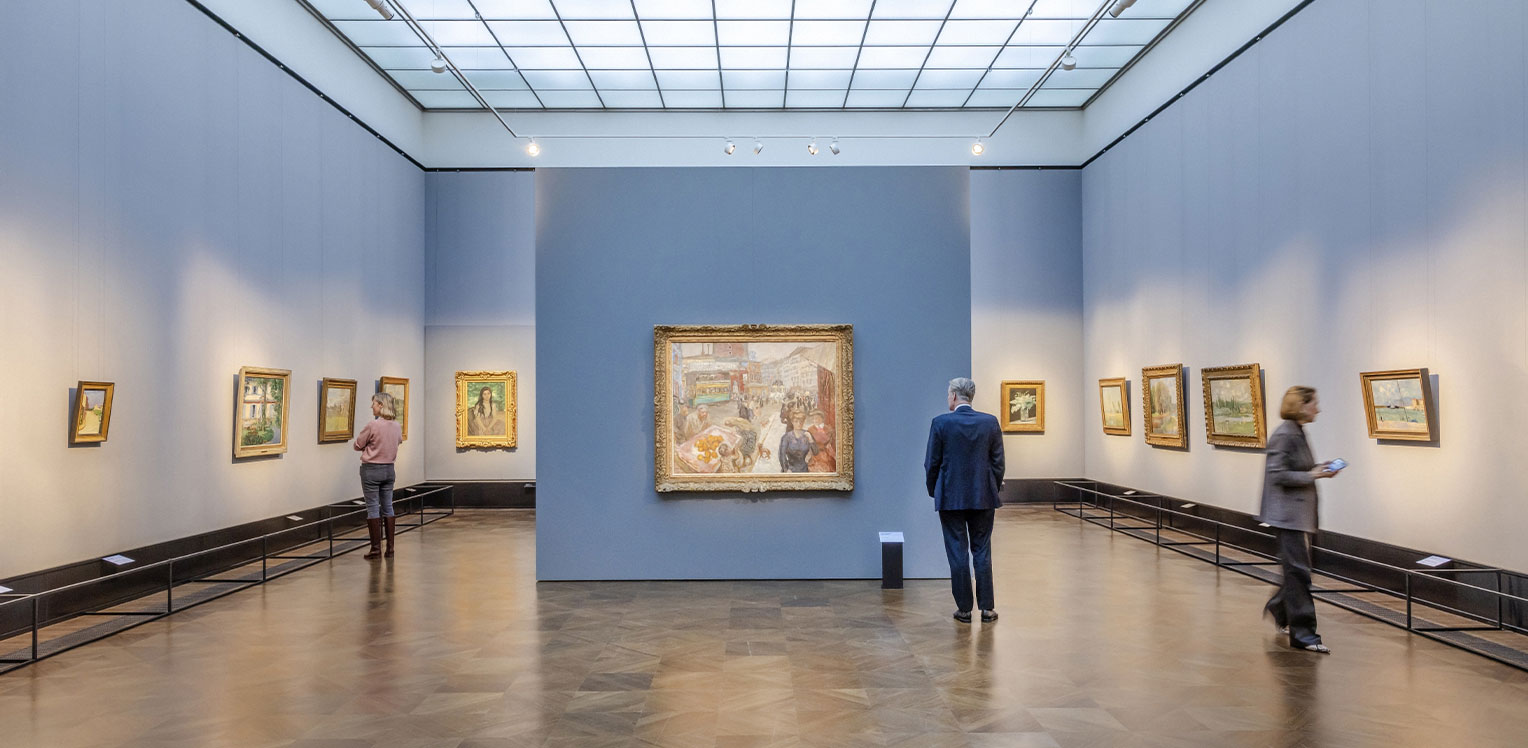
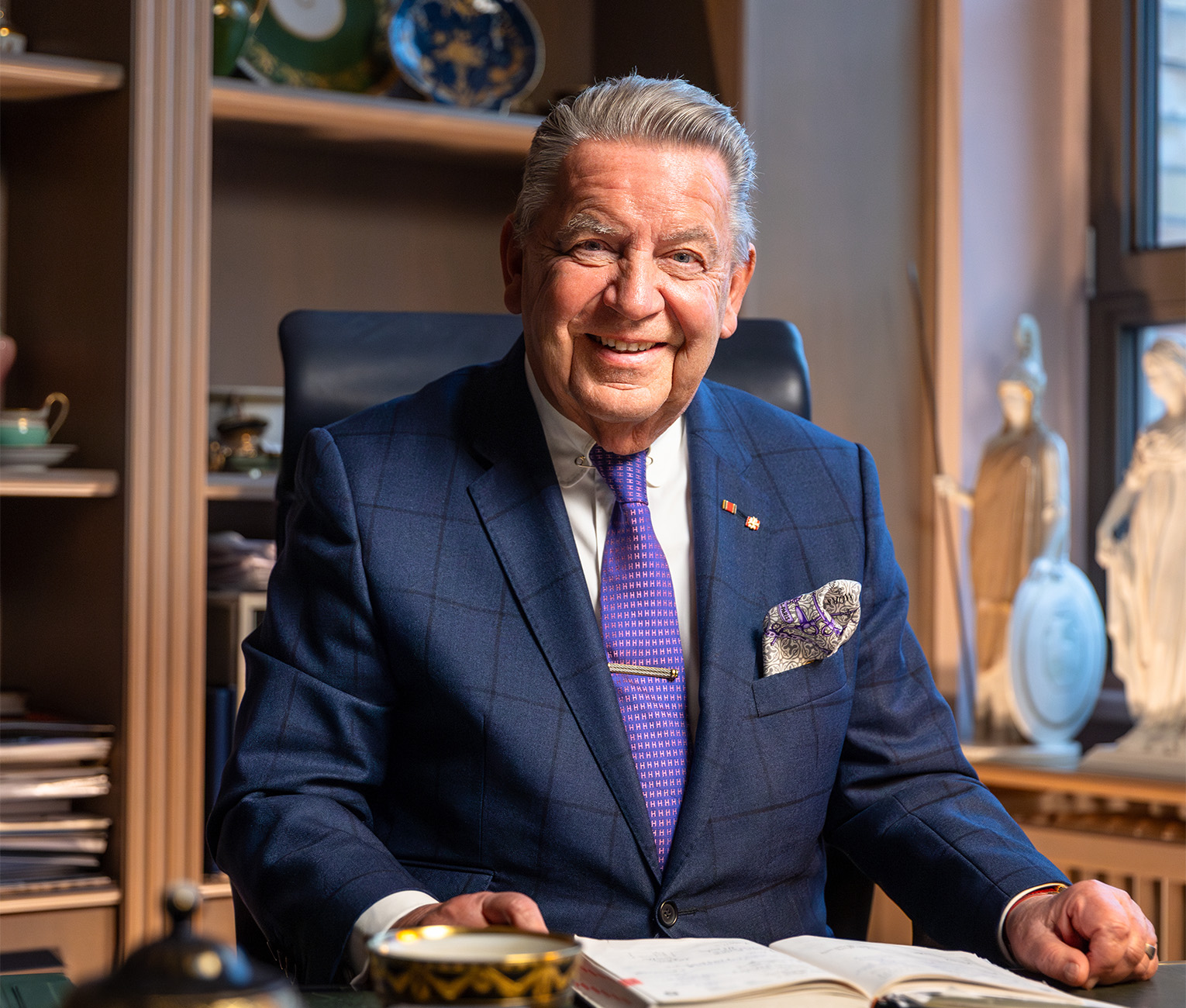
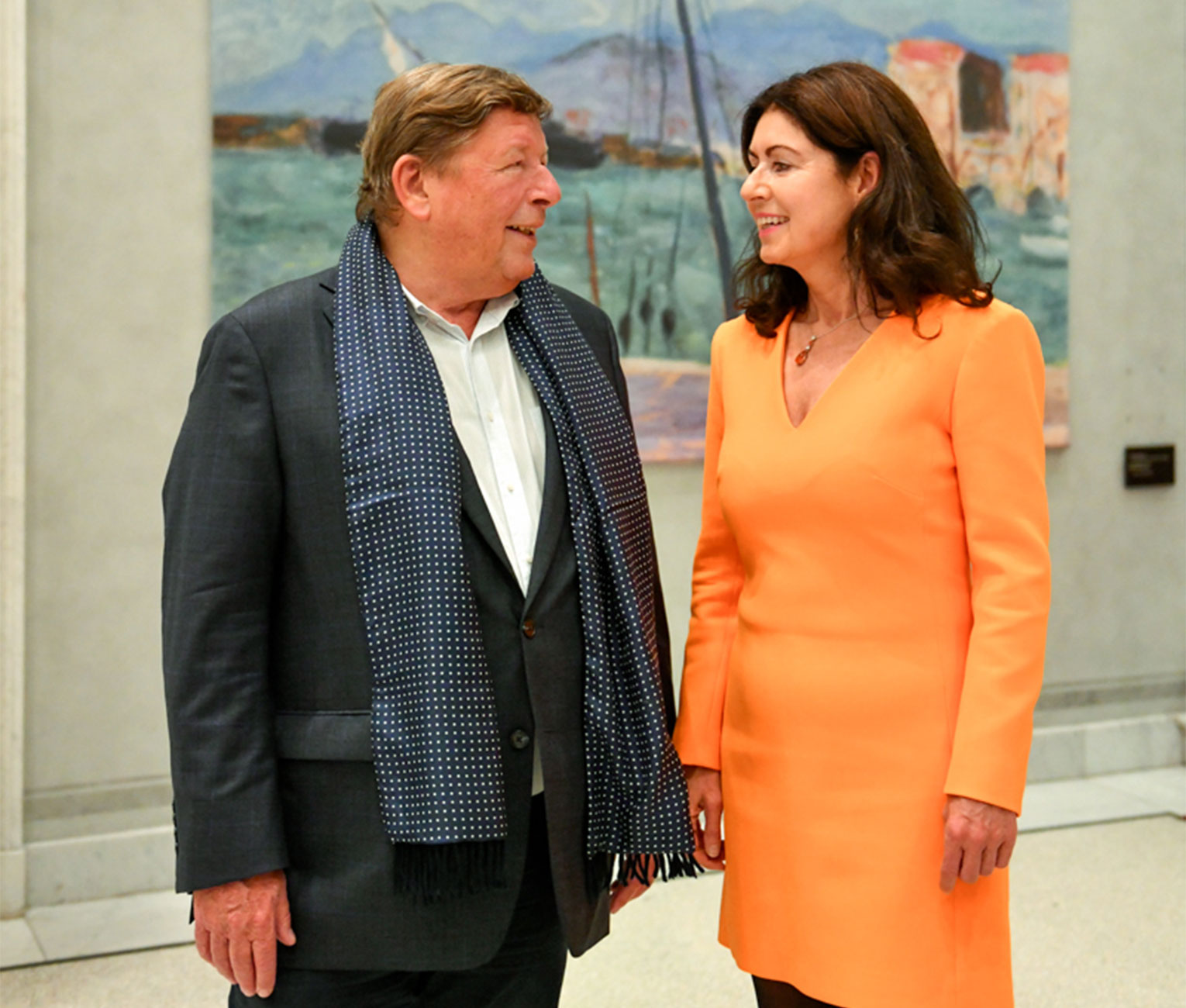
We first meet René and Christiane Scharf among the paintings themselves. Between Monet’s Waterloo Bridge, works by Renoir, Cézanne, Bonnard, Goya, and Toulouse-Lautrec.
Later, away from the museum galleries, in a more private, quieter space, the conversation continues. Only there does it become fully apparent that this collection is not merely an asset or an ensemble of masterpieces, but a family tapestry woven from decisions, loss, perseverance – and shared battles.
AVIAIR: Standing here among these works – from Goya to Monet and into the present – the question inevitably arises: what led you to show your collection now?
RENÉ SCHARF: The collection has been around for a long time. The Nationalgalerie first approached us in 2009 – there were initial conversations, then the whole thing faded again. About three years ago, Professor Parzinger, then president of the Prussian Cultural Heritage Foundation, came back to us and essentially said: “Now would be the time – show it at the Alte Nationalgalerie. It would be such a good fit.”
We then sat at home and asked ourselves: what if we do nothing? Then this collection remains something that perhaps thirty or forty people a year see – friends, colleagues, the occasional museum, and even then usually only individual works. Across generations, we have always been lending artworks to museum exhibitions worldwide and on an anonymous bases, but the collection as a whole would have remained invisible.
CHRISTIANE SCHARF: And in the catalogues it always just said “Private Collection.” Never where the works actually came from. And that aspect, going public with our name, took us a while to accommodate with and to overcome concerns. There were loans over the years – worldwide, to major institutions – but the collection as a coherent entity was never visible. We finally decided that the collection deserves to be seen as a whole. This exhibition shows, for the first time, what has been created across four generations.
You studied art history, worked at Christie’s, at MoMA, at the Wallraf-Richartz Museum, at the Museum Ludwig, and spent twenty years as an art dealer in New York. How does that shape your view of your own collection – especially now that it’s being shown publicly?
RENÉ SCHARF: I grew up with this collection, but I never saw it merely as “property.” I always experienced it in relation to museums, galleries, other collectors. Early on I learned that there’s a difference between a work you “like” and a work that is truly art historically significant.
Working in museums teaches humility. You learn how much art builds on what came before. The Barbizon school – Corot, Courbet, Daubigny – prepares so much of what later happens in Monet, Cézanne, Bonnard. And when you suddenly have Renoir v next to Cézanne in your own collection and you see how a brushstroke, a subject – say, the bathers – moves from one to the other, you realize very clearly that your own collection is part of a much larger narrative.
And then there are the specific stories: our Waterloo Bridge by Monet was recently at the Courtauld Institute in London – in an exhibition reconstructing a historical show by the Galerie Durand-Ruel. Monet himself selected 26 works from over a hundred London scenes – Waterloo Bridge, Houses of Parliament, Charing Cross Bridge. Knowing that this painting is part of a selection of Monet’s favorite paintings, makes it even more special to me.
Responsibility is a fitting keyword. Owning a collection like this comes with great responsibility.
RENÉ SCHARF: Yes. First the practical side: deciding which institutions receive works, in what context they’re shown, whether a painting travels or not. It’s always a balance between protection and access.
And then there’s the long lineage: my great-grandfather laid the foundation, my grandmother fought to keep the collection alive through the war, my parents rebuilt in the postwar years, and we continue and expand today. You’re never acting alone. You can’t just say, “Let’s sell everything and buy an 80-meter yacht.” It might have been theoretically possible – but it would have betrayed the generations before us, and the idea that art is something larger than oneself.
CHRISTIANE SCHARF: And responsibility also means working not only with the artworks but with the structures around them. This exhibition didn’t simply happen. There were contracts, transport questions, restorations, insurance matters, hanging concepts, political and bureaucratic processes and it surely helped that I am a lawyer by profession. Without proper documentation, without always thinking one step ahead and with us often trying to find creative solutions, much of this would not have been possible.
Your great-grandfather – who was the man who started all of this?
RENÉ SCHARF: My great-grandfather, Otto Gerstenberg invented a completely new form of life insurance and was the founder of this collection. He was director-general of the Victoria Insurance Company, which had branches from Portugal to Hungary, as well as Istanbul and Beirut. At a time when communication was essentially limited to telegraph cables, this was a logistical and organizational feat.
With this success, he collected – initially prints: Dürer, the complete Rembrandt prints, Lucas van Leyden. Later Goya became the core: the Desastres de la Guerra, the Tauromaquia. From Goya to Toulouse- Lautrec – that was his time axis. Barbizon, Corot, Courbet, Delacroix – and of course Renoir. Some of the most beautiful Degas and Renoirs he acquired now hang in the Hermitage in St. Petersburg, including the Place de la Concorde by Degas, which is considered the start of modern art.
Because they were seized?
RENÉ SCHARF: They were taken to Russia by the Red Army after the end of World War II. Under the Hague Convention they would actually have to be returned. So far, they are not, but at least they can be seen at the Eremitage in Saint Petersburg and the Pushkin Museum in Moscow.
Your grandmother then had the task of bringing the collection through the war. How does the family look back on her role?
RENÉ SCHARF: She had one of the most thankless roles imaginable. My grandfather died young, and my grandmother had to navigate the collection through a war whose dimensions no one could foresee.
The then-director of the Nationalgalerie, Dr. Justi Rave, wrote to her in 1942 suggesting she might place the collection “in the care of the Nationalgalerie.” It was meant as protection – and in some respects became the opposite. Some works were brought south, others remained in Berlin or were placed in bunkers. Some were destroyed, others taken later by Soviet troops.
CHRISTIANE SCHARF: And yet she managed to save a significant portion. The bust of the great-grandfather by Reinhold Begas was found on a pile of scrap metal after the war. Someone recognized it and pulled it aside – otherwise even that would have been lost.
RENÉ SCHARF: In the catalogue texts my grandmother was long meant to disappear entirely in the view of the curator as she did not enlarge the collection, but “just” protected it. It always said “three generations of collectors.” We insisted: absolutely not. She may not have acquired works, but she preserved the collection in a time when it could have vanished altogether. You cannot erase that achievement.
Then comes your mother, whom you speak about with great respect. What was her role?
RENÉ SCHARF: My mother was essentially the custodian of the collection. She held everything together. Her father owned a company – AKS, Arnold Kiekert Söhne – that produced locks for Mercedes, Volkswagen, Ford, Opel. He invented the steering- wheel lock and, more importantly, the central locking system. One in three cars worldwide still uses AKS technology today.
She was a medical doctor by training and – when her brother dies in WW II, was the only women at her University to study mechanical engineering in order to run the company. She would have preferred an academic career, but grew into the company and was ultimately the one who sold it – creating the financial stability that allowed the family to continue the collection without having to break it apart. She also thought in terms of content: knew which works had to stay, where additions made sense. My father was a passionate collector with a great eye and an impressive sense for top quality. In that sense, my parents were a great team.
CHRISTIANE SCHARF: And it’s important to remember how often women vanish in these narratives – the grandmother, the mother. In the legal work around the catalogues and contracts, it mattered much to us to make their roles visible.
How were the holdings divided after your grandmother's death?
RENÉ SCHARF: When my grandmother died in 1961, the collection was divided between my father and his brother. They trusted a Swiss art dealer who devised a point system: each work was assigned a point value based on significance, value, format. Both brothers received the same point budget.
My father, as the elder, chose first: he could select one major piece with many points or several smaller ones with fewer. Then his brother chose – tit for tat. Each branch built its own collection without destructive conflict.
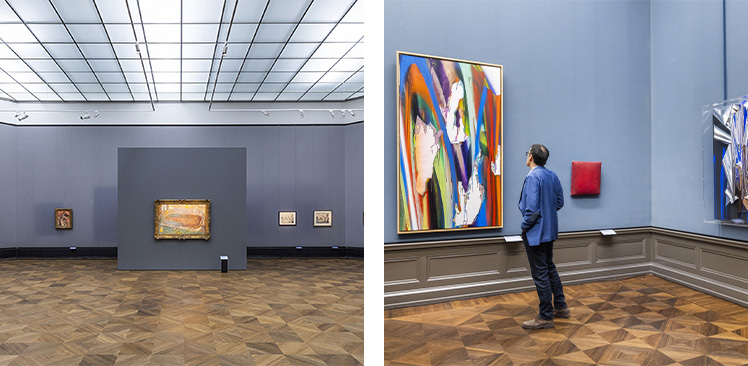
My uncle leaned more toward Symbolism and Surrealism; my parents remained close to the original axis: Impressionism, Post-Impressionism, Cézanne, Bonnard and later École de Paris. The American positions such as Jasper Johns and Sam Francis, I bought during my time in New York.
Mrs. Scharf, you are a lawyer and essential for making the exhibition possible. What kind of responsibility do you feel toward the collection, and how did you grow into this role?
CHRISTIANE SCHARF: My approach to responsibility came through other fields – mandates, contracts, negotiations for international film and media projects. This trained me to always think steps ahead and to answer questions before they are being asked. On our private level, at first I was simply “the wife of the collector.” But the more I understood the history and structure of this collection, the clearer it became that this wasn’t a hobby to be maintained but a cultural legacy.
As a lawyer, I am used to working on complex, international, multilayered projects. I was happy to contribute to the exhibition on that part, such as for exampledeal memos, clear contractual structures with museums, insurance aspects, safety and protection of rights – including the family narrative. More than once, it proved to be very helpful that we had proper contracts, even though the classical handshake deal still also exists in the art industry.
RENÉ SCHARF: I would eventually have let certain things slide. Christiane didn’t. She insisted on a solid foundation for every step. That’s one of the reasons we can speak about all this so calmly now.
A practical example: what happened behind the scenes before the first crate even reached the museum?
CHRISTIANE SCHARF: Every exhibition starts with something seemingly simple: a work list and photographs, measuremnets of all artworks, proper provenance research and documentation, condition reports end restauration, having crates built for the shipping, to name a few. To fill these aspects with life: three conservators spent six or seven weeks with us, taking down each canvas, cleaning, repairing frames, renewing gilding. A sort of wellness treatment for the collection.
RENÉ SCHARF: In parallel, logistics: crate construction, climate crates, transport windows. One hundred fifty works mean one hundred to one hundred fifty crates. And it’s not enough to set a date – you have to know whether anyone is working in August, whether workshops are on holiday, whether there are enough climate crates available.
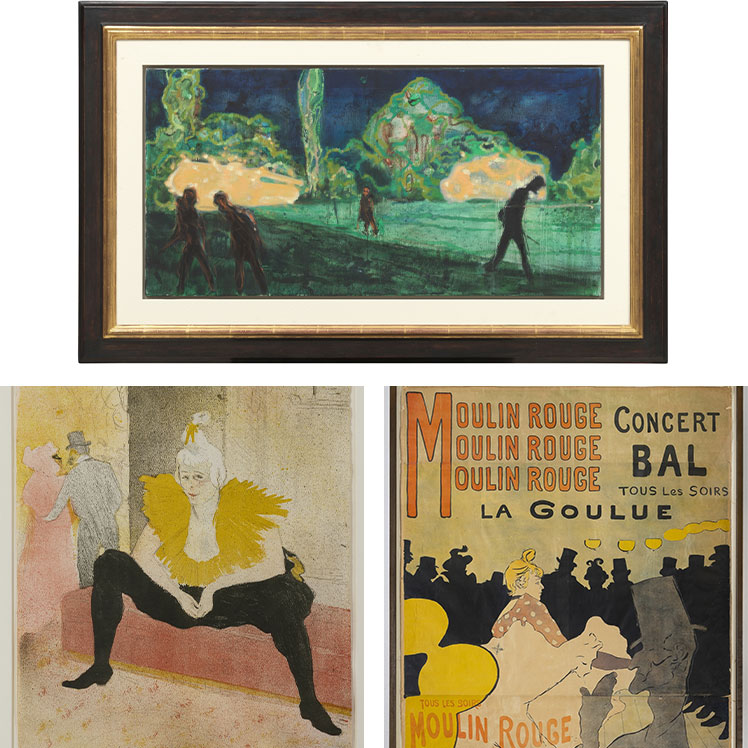
Let’s come back to the works. Toulouse-Lautrec plays a major role in your collection, particularly the Elles series. What draws you to it?
RENÉ SCHARF: The Elles portfolio is Toulouse-Lautrec’s most famous series. They are scenes from brothels – but without voyeurism or distance. He painted these women as they really were: not idealized, not observed through a keyhole, but from within.
One important print, Eldorado, was still missing in the Collection and I searched for six years to find this particular sheet in the right state and very good condition and I finally found it in New York.
Looking at the structure of the collection: there’s the historical core – Goya, Barbizon, Impressionism – and then École de Paris, American positions, contemporary works. How do these lines fit together?
RENÉ SCHARF: My father focused heavily on École de Paris – Bazaine and Estève. I came back from New York with artists like Sam Francis. The École-de-Paris painters eventually sort of adopted him: “You’re one of us.”
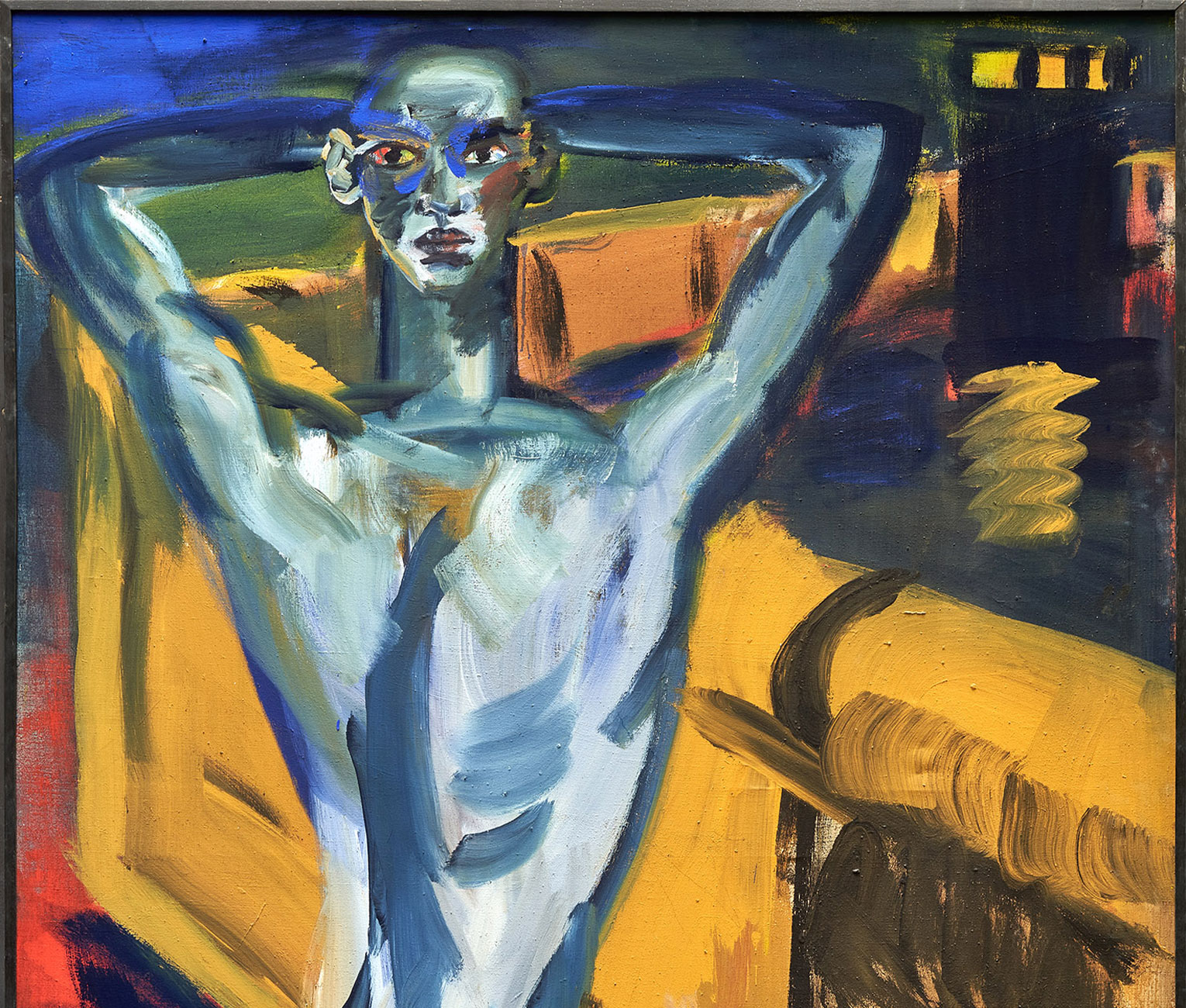
So a kind of arc emerges: my father’s French modernism, the American abstraction I brought in, and then positions like Daniel Richter, Jonas Burgert,” Katharina Grosse. You can walk through the collection and see how certain themes persist: color as substance, light as material, surfaces that begin to vibrate.
Do you have favorite works?
RENÉ SCHARF: Of course. The Picasso in the Cubism room is magnificent, Monet’s Waterloo Bridge is a key work. And of course Bonnard’s large bathtub, one of three versions, which depicts Bonnard’s wife Marthe, always appearing as a young women even in her late years. But it’s always difficult to highlight individual works, as I like all of them. The collection functions as an ensemble.
After Berlin, the exhibition continues in Düsseldorf and is expanded there. What awaits visitors?
RENÉ SCHARF: In Düsseldorf – at the Kunstpalast – the show will be on more space, with additions. Particularly important are the Japanese woodcuts added there: Hiroshige and others who caused a sensation in late 19th-century Europe.
Nearly all the artists we show here – Monet, Bonnard, Cézanne, Toulouse-Lautrec – collected Japanese prints. Their influence is visible in composition, the treatment of foreground and background.
In Düsseldorf we can make that line clearer: visitors will see not only European modernism, but also the images that inspired it.
Your collection is called “The Scharf Collection,” not “Sammlung Scharf.” Why was that distinction important?
RENÉ SCHARF: The name isn’t just cosmetic. There is the Sammlung Scharf-Gerstenberg – run by my cousin – with its own direction. We needed a name that works internationally and clearly signals a separate, independent collection.
“The Scharf Collection” is clear, rhythmic, and marks a boundary without denying origins. Otto Gerstenberg remains the beginning – but we carry forward our own story.
CHRISTIANE SCHARF: And it was important not to pit the generations against each other: who acquired more, who is “more important”? Each generation had its tasks and sacrifices: building, surviving the war, rebuilding, expanding into the present. We see the collection as a whole, not as an accounting of individual achievements.
And what comes next? Do you continue to collect – or does there come a moment when you say: “That’s enough”?
RENÉ SCHARF: The walls are finite – that’s the honest answer. It would be a shame for significant works to sit in storage. So, we collect much more selectively now.
CHRISTIANE SCHARF: At the same time, there are artists we feel are missing. Alicja Kwade, for example. We’ve been circling that question for some time: what would have a real place in the collection – not just in crates. It’s more a focused continuation than the kind of collecting where something new arrives every week.
RENÉ SCHARF: And that’s the beauty: something is always missing. A collection that is “finished” is a dead thing.
In one of your remarks you said, “Art never truly belongs to you.” What do you mean by that?
RENÉ SCHARF: We own these works only for a limited time. We can protect them, live with them, show them – but we can’t bind them to us. One day we won’t be here anymore, and someone else will look after them, hang them differently, weigh them differently.
For me, that’s comforting. It removes the pressure to make every decision definitive. There is responsibility – museum-level, legal, conservation responsibility. But art is bigger than we are.
CHRISTIANE SCHARF: Perhaps it’s a little like a very old tree. It stood there before you were born, and it will very likely still be there when you’re gone. You can tend it, protect it from damage, support a branch. But you don’t ultimately own it in perpetuity
When I finally emerge from this world of images and centuries, something remains with me – a quiet, lasting respect. Not only for the history of this collection, but for the attitude with which René and Christiane Scharf approach it. They treat these works as a loan held only for a time – protected, cared for, carried forward – with the understanding that they do not belong to them, but will pass through their hands into the future. Perhaps that is what moved me the most: the realization that preservation is never ownership, but responsibility.