
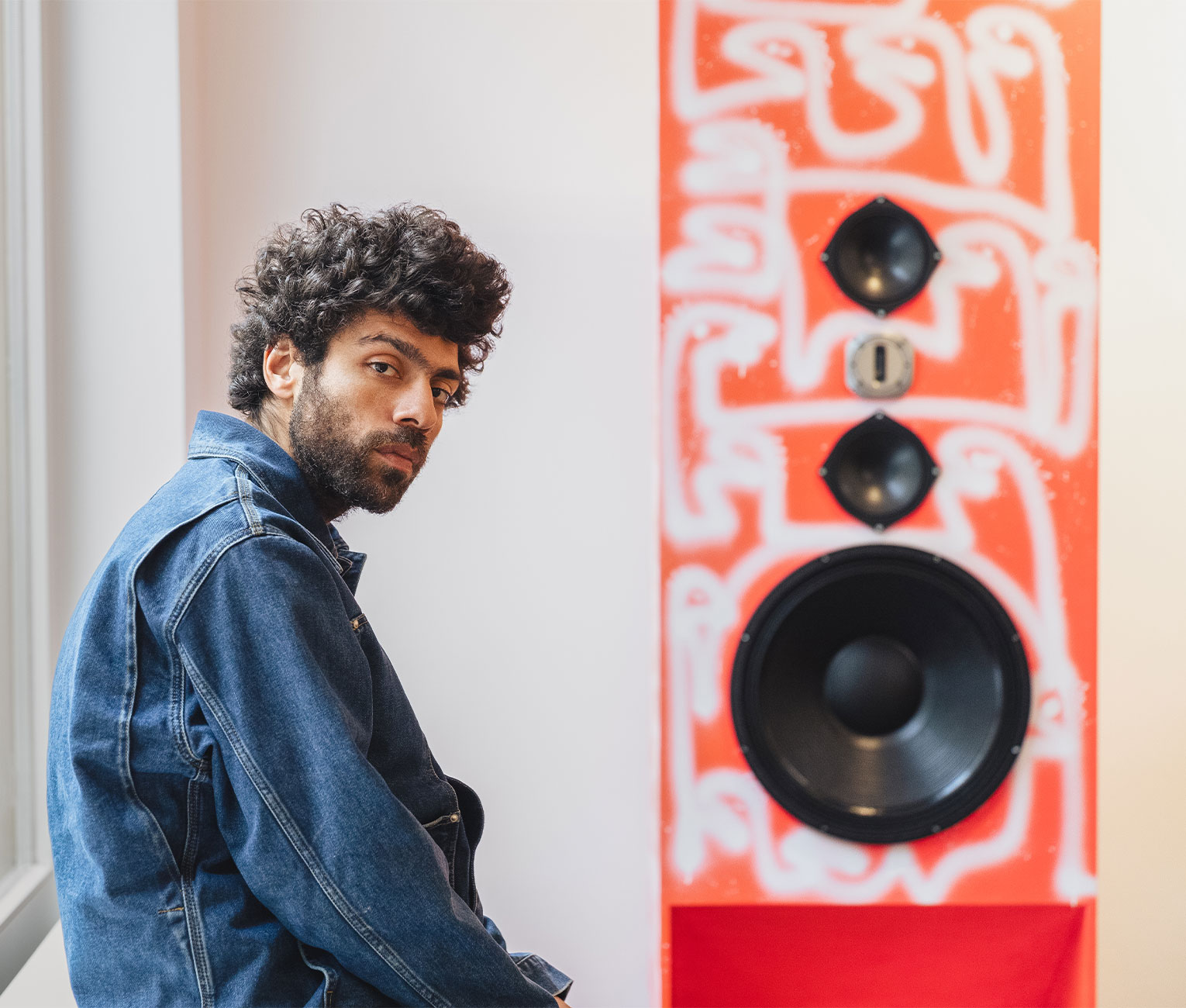
NOAH BECKER ON ART, FRICTION, AND THE RIGHT TO CHANGE
Fear usually means I’m on the right path.
That night, you could feel what good art can trigger: disturbance. Connection. Curiosity. Amidst Becker’s large-scale works stood an artist who approached people rather than elevating himself above them. Noah Becker was there – with his art, his quiet presence, his self. And with a way of being that touches the heart.
What followed was more than an interview, more than a series of questions and answers. AVIAIR’s Editor-in-Chief, Sabine Kühlwetter Meiers, spoke with Noah Becker – there in the exhibition, between the paintings; not just about art, but about perspective.
AVIAIR: Why Berlin?
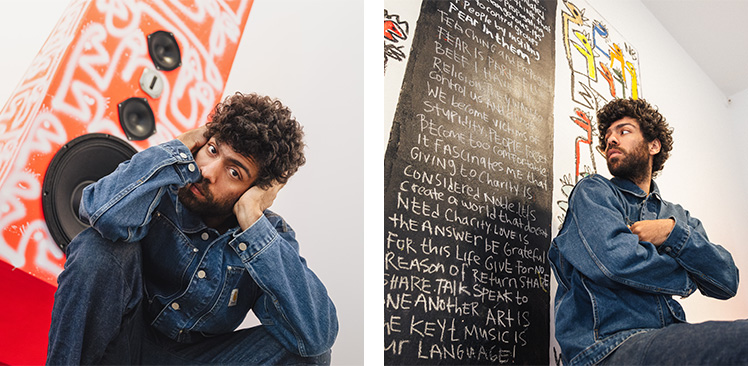
NOAH BECKER: Berlin has never just been a place I live – it’s a place of learning, a toolbox. Open, raw, full of contradictions. I’ve tried out so many things here, scrapped ideas, rethought them. It’s been a space for friction – and that’s exactly what I needed.
And that’s why you’re showing here, at Galerie Deschler?
Yes, because of the atmosphere, the people, but also because of the proximity to the other artists represented by Deschler. It’s an honor.
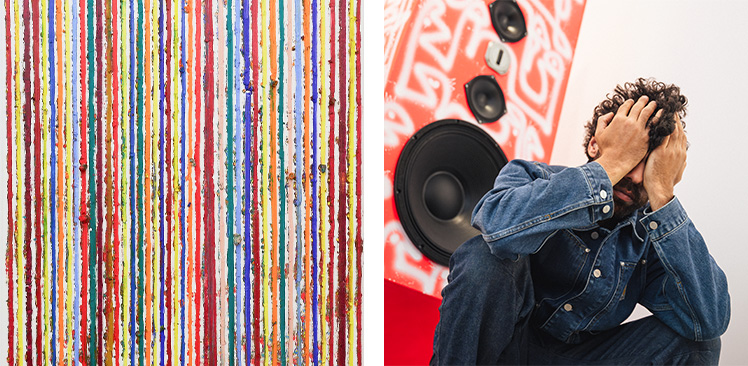
Noah Becker‘s works process environments, encounters, memories – they’re like maps of inner and outer spaces. Music plays a central role in his life. “As a kid, I was always taking apart drum machines,” he says. “I wanted to understand how it all fits together.” The rhythm of his painting is audible. Tangible.
When you transfer that rhythm into your works – when you start a piece – how does it come to you? Is it a feeling, a color, an external stimulus? What inspires you?
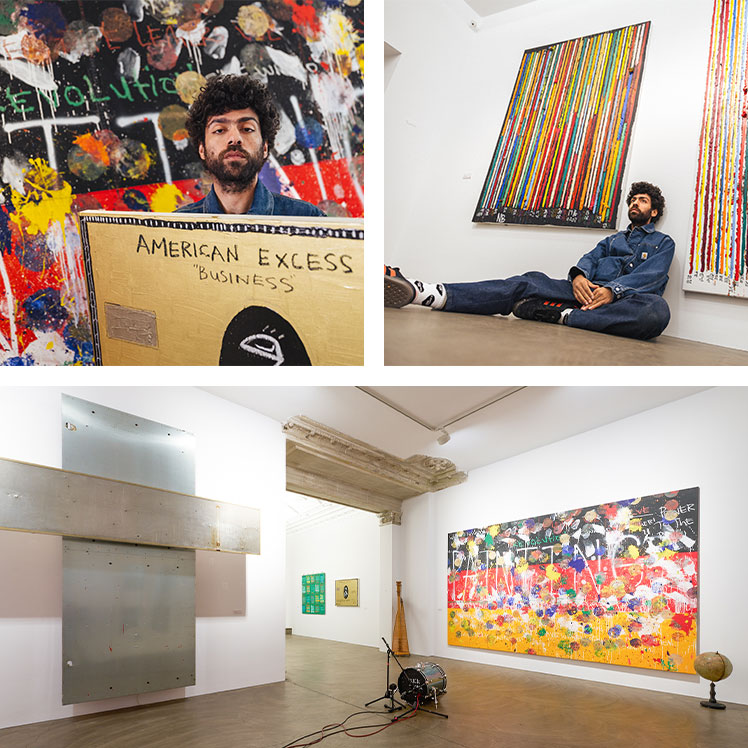
It’s definitely a feeling. When I paint, my mind is actually pretty quiet. The thoughts come beforehand – they’re already there before I begin. I think a lot, and I try to make those thoughts visible in my work. We live in a pretty crazy time, with all the contradictions, capitalism, injustice – all of it. That influences me. I want to express it, process it, question it. Art is my way of doing that. I’m honored that I get to make art – and I take that seriously. I think it’s incredible when people leave an exhibition with something they can take with them. When they have a story to tell, something they feel. That’s the most beautiful thing.
Noah Becker says he wants to understand what lies beneath the surface – both in himself and in others. “I observe a lot,” he says, “not just the world, but myself in it.”
What lies beneath the surface here? Is it about engaging with society, about how we treat each other, about trying to connect in a good way?
Definitely. But it’s also about confronting myself. I grew up with a lot of privilege, saw early on how fascinated people are by fame. But I always asked myself: Who am I, really? Who am I if you strip all that away? Not who people know, but who you are. That’s what I’m interested in – people, their stories, how we’re all connected. To the universe, to plants, to art. I think we all have a responsibility to care for each other. Art and artists need that space – to uplift each other, to see each other, to support each other.
When you speak about art this way – as an outlet, a tool, a way to understand the world and yourself – I wonder: Is art a way for you to break free? Or did you always set out to become an artist? Was it a conscious path, or did it just happen to you?
I think it’s both. From an early age, I was drawing, making music, playing sports – anything I could get my hands on. It was always there.Having role models – people in my family, in my circle, who worked in different mediums with care and sensitivity – shaped me. They showed me: you don’t have to plan everything, but you have to stick with it. Art is a process. It’s constant experimentation. “Find your own style,” they say. But in the end, style can also hold you back. You have to learn – and then unlearn again. That’s what I’m interested in: not holding on, not getting stuck, but staying open.
For Becker, art is a space where contradictions are allowed to surface – a place to ask questions that are often left out. His works are an engagement with the world that doesn’t stay abstract but becomes concrete. Take his piece “15 k” – a collage of torn newspaper articles about a racist attack on him. The artist didn’t just rip the articles apart; he also painted over them with boxing gloves dipped in paint. The texts are obscured, covered in color, erased. “I wasn’t painting,” he says. “ I was boxing. It had to come out.”
His art is not just an expression, but a ritual. A way to make sense of the world’s chaos, to counter the restlessness. Spirituality, untethered from religious doctrine. Noah Becker says he recites a small poem, a kind of prayer, before every meal – a quiet moment of gratitude for life. “For me, spirituality comes from within, not from a book.” It’s a conviction rooted not in dogma, but in empathy: “Everyone decides for themselves how they live, what they believe, what God they have. But at the end of the day, we’re all connected. We should just be kind to each other.”
This feeling echoes in his work – like in Shine Your Light. The glowing cross made from old metal burger joint signs – found, cleaned, painted – is not a religious symbol in the traditional sense, but a quiet sign of connection.
At the end of the day, it’s about what connects us: love, care, respect.




Almost an antidote to the exhibition title Face Your Fears, which calls for confrontation and courage. With Shine Your Light, Becker creates a counterpoint – a place of light, togetherness, hope. “It’s not about believing in a particular God,” he says. “At the end of the day, it’s about what connects us: love, care, respect.”
This search for connection, for empathy, runs like a subtle pulse through Noah Becker’s entire body of work. His art asks: What remains when you strip away the labels? When you let go of the system, the convention, the status? Symbols in his work – like a golden credit card, suddenly no longer about power or status, but about history. About association. About transformation. The artist deconstructs these symbols, reassembles them – just as he processes things, asks questions, shifts meanings. Everything flows, nothing stays fixed.
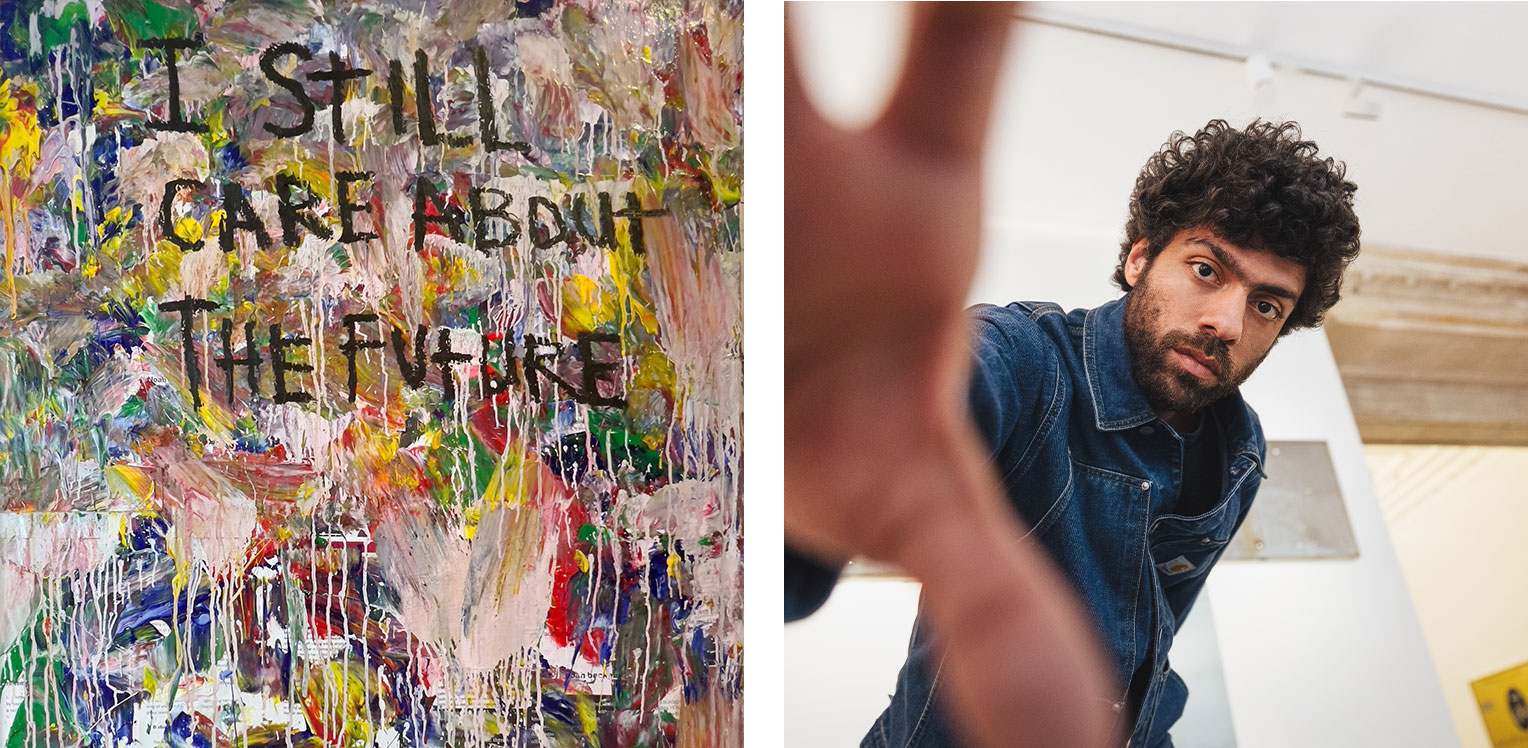
Noah Becker also uses language as a symbol. The phrase Bleib wie du bist (“Stay as you are”) appears on the work of the same name – a self-portrait, naked, vulnerable, with a phrase Becker has often heard.
I was afraid of that painting. And so I knew: I had to make it. People would say to me, “Stay as you are.” And I never knew: Is that a compliment – or a limitation? Is it meant kindly? Or is it a stereotype? Like: We had expectations. And you’re actually okay. But what does that even mean? I’ve often felt naked in those moments. So I literally had myself photographed naked. Seriously: We all change, we don’t stay the same. Even as a kid, I knew that. Change is inevitable. It’s the only constant. And that’s what I celebrate in my art. Everything else is an illusion. I think that’s why I paint: to hold space for that.
Noah, your works are simply extraordinary, bold. When did you start painting? You also exhibited a work at the MoMA in New York when you were just eight or nine years old.
(laughs) You’d have to ask my mother, really. But I think I started painting when I was four or five.
What began as childlike curiosity soon became much more. Music, art, sports – Becker tried everything, often at the same time. “I believe, if you dare, if you have the opportunities, anyone can start expressing themselves,” he says. “You need focus, yes – but above all, you need the desire to show something of yourself.”
And perhaps that’s the core of everything Noah Becker does today: he shows himself. Not loudly, not intrusively – but honestly. Sharing, he says, is the real reason we’re here. “Share something about yourself.” As the oldest of four siblings, he learned early what it means to pass things on. And how beautiful it is when others find joy in it. “It’s like at Christmas,” he says. “Getting something is nice. But giving something – that’s even more beautiful.”
“MEA CULPA” – LINES OF MEMORY
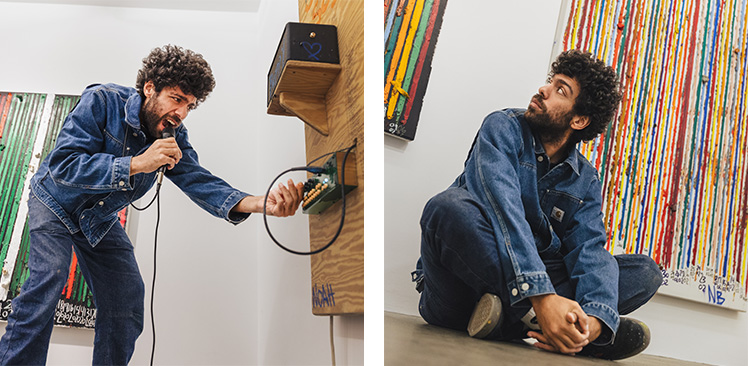
In one room of the exhibition, a series of works quietly but insistently draws the eye. Lines, numbered. At first glance, they appear graphically reduced, almost clinical – but it’s precisely this restraint that gives them emotional depth. These are works from Noah Becker’s Mea Culpa series. Each line represents a stretch of time. A day. A memory. A confrontation.
You’ve said a piece only becomes complete through dialogue with the viewer. That must also apply to the Mea Culpa series – though the series itself is an ongoing project. How did it come about?
The series grew out of a need to capture moments in my life. Moments when I craved structure, rhythm. I started drawing lines daily, with dates – like a visual diary. During a conversation with my mother, who has always played a strong role in my life, we disagreed about one of the works in the series. A few days later, she called me and said, “You were right. I’m sorry.” And I said I was sorry too. Then she suggested the series should be called Mea Culpa. That touched me. Art as reconciliation. As a language.
And you’re continuing the series?
Yes – whenever I’m in that clear, calm energy. Maybe one day, there will be 300 of these works lined up. And then a pattern will emerge, a rhythm. Or maybe not. It’s a process.
The title – Mea Culpa, Latin for my fault – is not a confession in the classical sense, but a poetic reflection. A form of retrospection. Of opening. Of self-inquiry. “These works keep happening,” Noah Becker says. “They’re not planned. They come to me. I document them.”
That Noah Becker continues the series gives it a meditative quality. The repetition becomes a ritual; the personal becomes serial, and the serial becomes intimate. A body of work that doesn’t aim for a destination, but Noah Becker creates space. Its power lies in its stillness.
Then he says a sentence that sounds almost casual, but lingers:
“There are always two options: to respond with fear or with love. I believe love always wins in the end. And that’s what I want to show with my art.”
Noah Becker doesn’t meet us as someone trying to impress. He comes across as someone who means what he says – and feels what he does. In his presence, you sense authenticity. Not as an attitude, but as a conviction. He listens, he looks closely, he asks questions. His art often begins where words fall short: in the nuances, in memories, in unrest. And that’s where its value lies.
At Galerie Deschler, among people, artworks, and conversations, this essence unfolds with particular clarity. It’s a quiet moment of openness, carried by trust – in the space, in the other, in one’s own voice. The artist doesn’t create from vanity, but from conviction. His works are not escapes, but confrontations. With himself. With the world. With what remains when all the labels are stripped away.
What emerges is not a finished answer. But an invitation. To join in. To reflect. To see differently.
This conversation with Noah Becker moved us. Not just because he speaks so openly about his work, his life, and his values, but because he does so without seeking the spotlight. Here sits a young man who reflects, listens, and tells stories – while also asking the right questions, of himself too. His art is a reflection of that, his work a growing process. We can’t wait to see, hear, and experience what comes next. Because it’s clear: Something is emerging here. Something real. Something that lasts.