
POSITIONS OF THE "JUNGE WILDE" – ANNIVERSARY EXHIBITION
NACKT brings together works by Rainer Fetting, Elvira Bach, Luciano Castelli, and Salomé – artists whose figuration in the 1970s and 1980s broke open prevailing norms with unmistakable intensity.
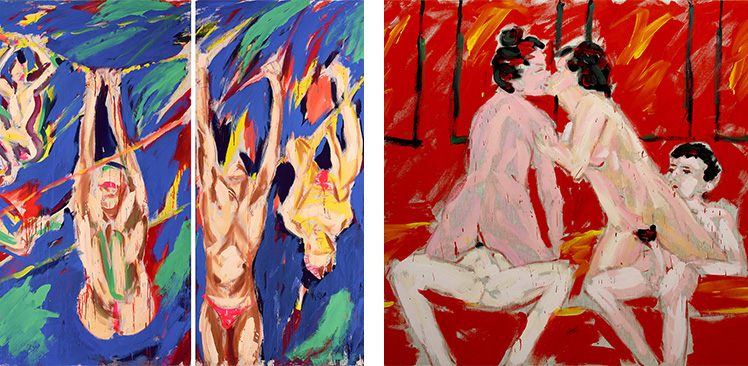
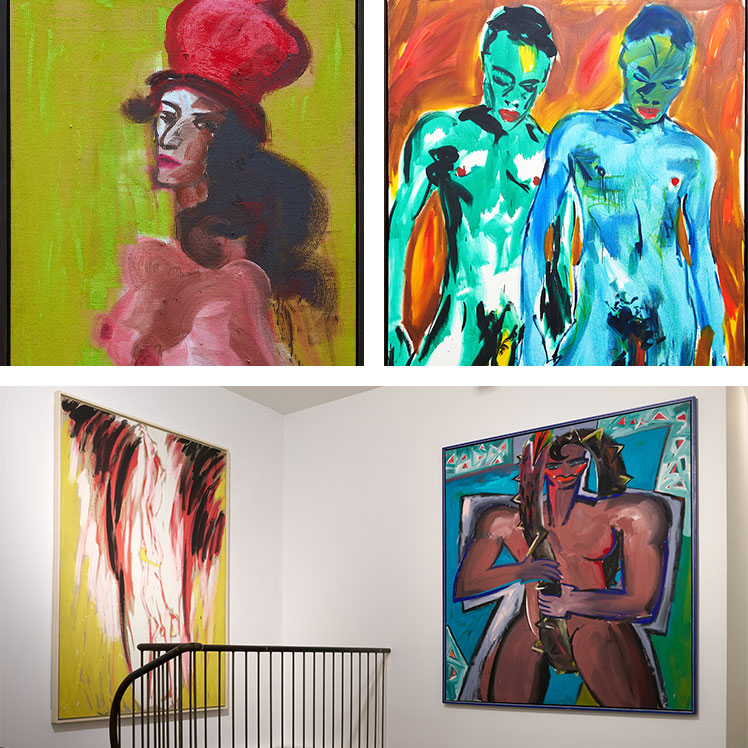
The exhibition revisits a period when depictions of the body sought not to smooth but to reveal. Fetting, Bach, Castelli, and Salomé present a closeness that allows no distance: sensual, direct, vulnerable, unguarded, and always unequivocal. These nudes are not observations but encounters – and they carry the very energy that shaped the “Junge Wilde.”
BODIES CHARGED WITH ENERGY
Salomé opens this constellation. Since the early 1980s, he has been one of the defining voices of Berlin painting, renowned for his immediacy and passionate directness. His figures emerge in a field of tension between desire, fragility, and fearless openness. The bodies function like emotional surfaces – pulsating, unvarnished, unmediated. Nothing is smoothed or detached; each work carries a biographical urgency that remains palpable.
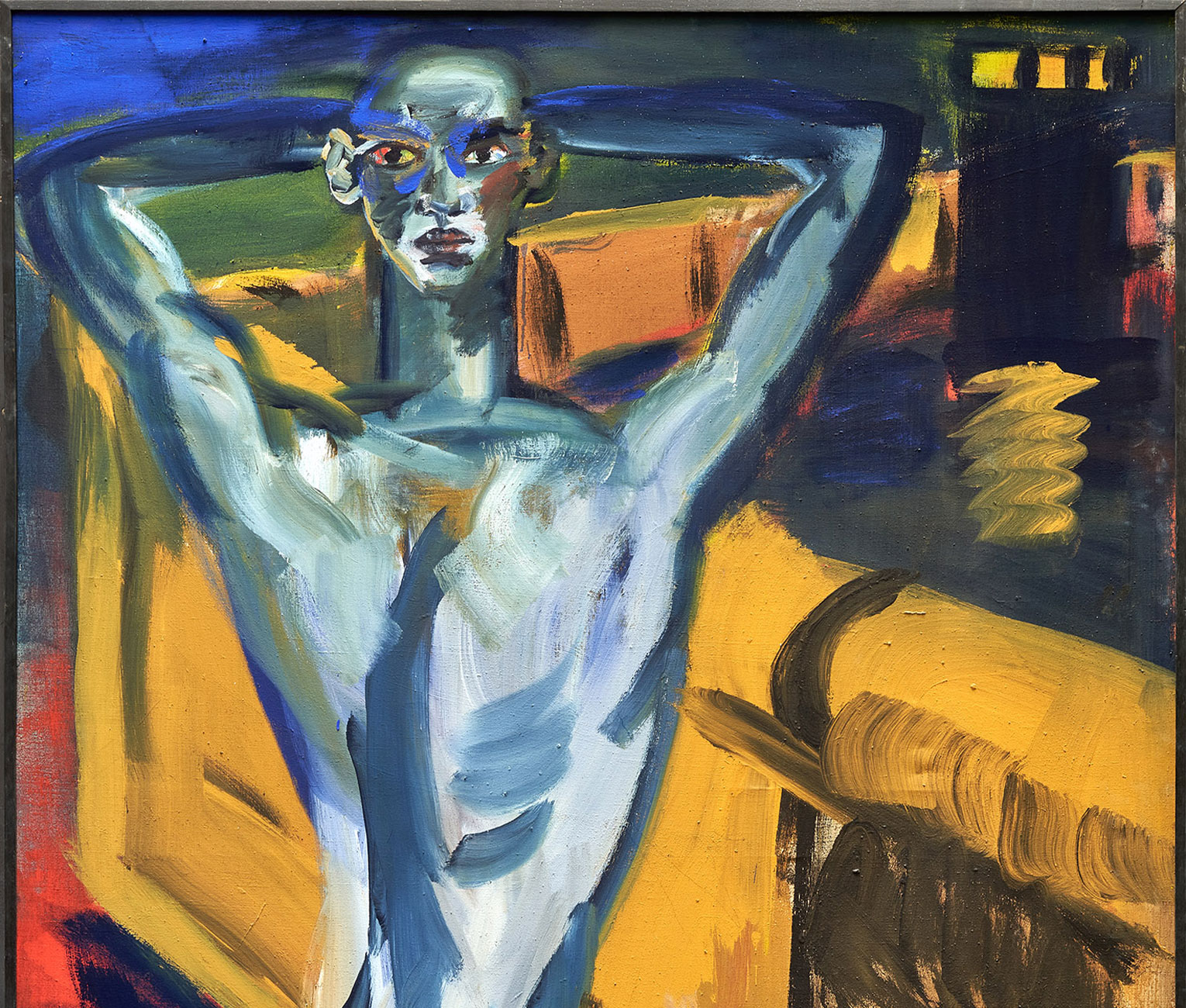
Rainer Fetting, member of the “Neue Wilde” (or co-founder of the “Moritzboys” or gallery at Moritzplatz) and a central figure of the West Berlin scene, approaches the body through color as pure force. His paintings vibrate; his lines feel like impulses. In “The wall” (1987), corporeality meets politically charged topography: a figure before the Berlin Wall – at once portrait, testimony, and inner tension line. Paired with the sculpture “Die Drehung,” the work opens a rare dialogue between painting and sculpture. Movement becomes mass in one, color in the other – two languages, one impulse.
Elvira Bach is among those who redefined female self-representation in the early 1980s. Her women are not subjects but protagonists – powerful, immediate, rendered in a chromatic intensity that asserts rather than interprets. Early on, Bach developed an image of the female body not as object but as voice. Her figures appear like leading characters: poised, bold, unmistakably her own.
Luciano Castelli, whose life and work in Lucerne, Berlin, and later Paris, brings a distinct tension to this grouping: the merging of body and performance. His early self-staged works – photographic, painterly, gestural – opened a new terrain of androgyny within the art of the 1970s and 1980s. Castelli draws the body not to define it but to liquefy it. His lines move like a dance – light yet intense, beyond fixed categories. Eroticism here is not a gaze but a movement.
REMEMBERING THE BEGINNING
In the basement, the exhibition returns to a pivotal moment in the gallery’s history: Gerhard Kehl’s “Blue Series,” with which Galerie Deschler opened on 16 December 1995. The works of the artist, who passed away in 2024, form a quiet counterpoint to the expressive rooms above. Precise, reduced, and almost meditative in their consistency, they speak of the beginnings of a place that has continued to generate new impulses ever since.
The return of the "Blue Series" is not nostalgia but a subtle tribute – a space in which the gallery’s origin becomes tangible without drifting into retrospection.
“NACKT” is more than an anniversary exhibition. It is a distillation of what has defined Galerie Deschler for three decades: visibility, artistic independence, and the courage to understand the body as a source of expression – unadorned and full of force.
The works point to a time when boundaries were crossed and definitions redrawn. At the same time, they embody the vitality that continues to characterize the gallery today: an openness that does not explain itself but reveals itself. What emerges is an ensemble that does not separate past, present, and future, but interlaces them.
When Marcus Deschler stood consciously before an artwork for the first time, he was still a child – yet he sensed something many adults only come to understand much later: that a picture is not simply looked at, it looks back.
That early intuition didn’t appear out of nowhere. He grew up in a home where art wasn’t explained, but lived – through conversation, collecting, and that quiet intensity that arises when people don’t own art so much as remain close to it. Works weren’t merely hung; they were debated, negotiated, recommended, defended. For Deschler, this wasn’t unusual. It was the language of his childhood.
Perhaps this is where the sensitivity began that still distinguishes him today – the ability to recognize a truth in images long before the right words appear. Three decades of gallery work later, that intuition is not a romantic idea but the inner core of his professional life: a steady, understated compass guiding him toward what deserves to be accompanied. When Deschler arrived in Berlin in the early 1990s, he encountered a city in the process of reinventing itself. No polished surfaces, no established structures – just spaces, biographies, possibilities. For someone who seeks the unvarnished, this wasn’t a challenge; it was an invitation. Without flourish, without a plan, without a safety net, he began a story that would grow into one of the most consistent presences in Berlin’s art world.



30 YEARS OF DESCHLER GALLERY
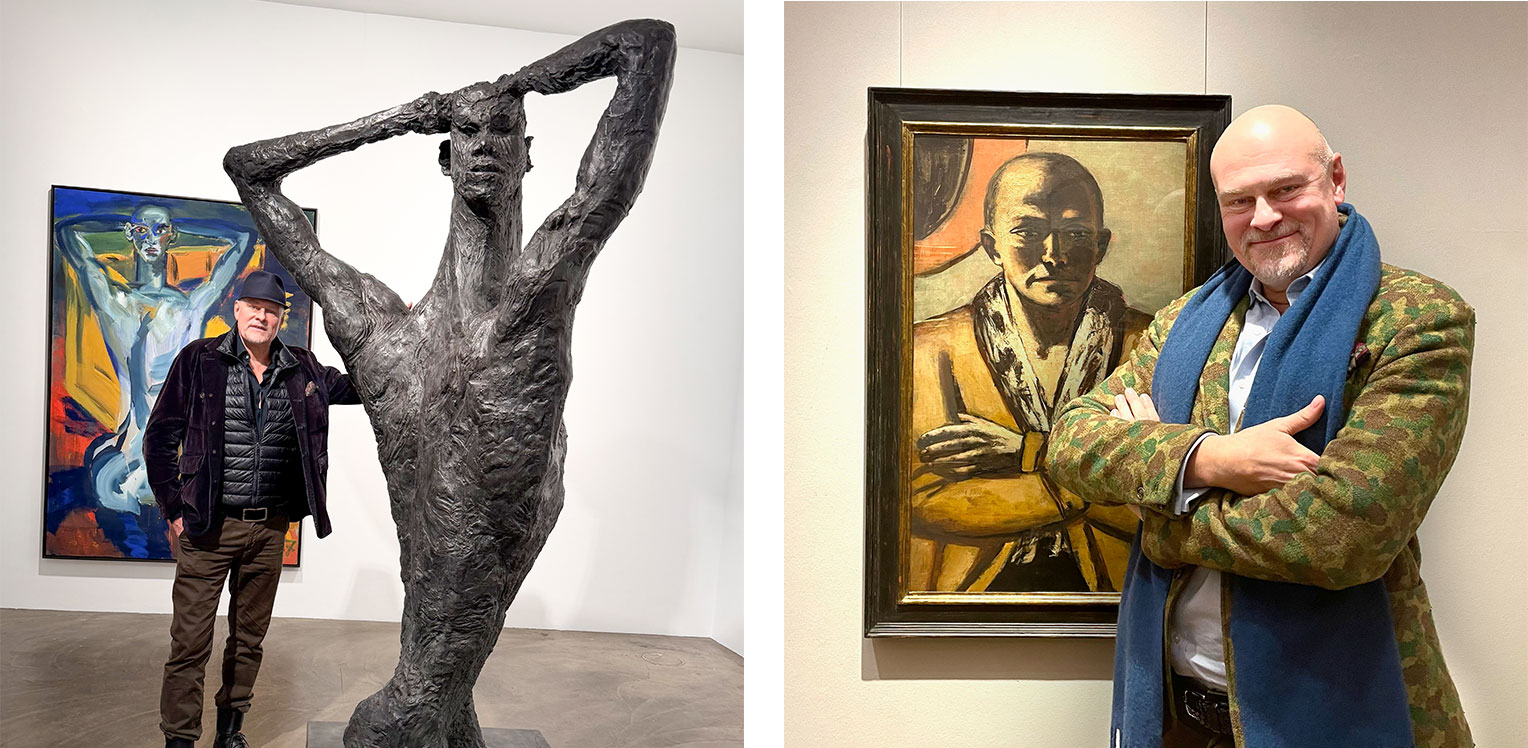
Marcus Deschler and the Art of Nearness
Deschler approaches art not as a market but as a relationship. His way of working follows no formula, only a fine intuition for the people behind the work. He meets artists not as a representative but as a conversational partner. He listens before he takes a position. He recognizes developments long before they become visible. And that, more than anything, has made his gallery a place where artists do not simply exhibit – but remain.
This trust has roots. It comes from a childhood in which art wasn’t an event but a rhythm. From teenage years in which encounters with artists were second nature. And from formative periods spent abroad – Paris, Singapore, Bangkok – where he learned how differently people think and work, and how essential openness is to any real connection.
That the gallery began in 1995 with a spontaneous newspaper ad says a great deal about him. It wasn’t a calculated move; it was an instinctive one: walk into a space, sense its potential, open the door. The rest followed – because people met people, not concepts.
THE BERLIN 90S
The Berlin of the 1990s was a moment in time when everything felt possible and nothing was guaranteed. Studios emerged in half-empty apartments, exhibitions were improvised, nights often ended where the next day began. For some, this era felt chaotic; for Deschler, it was a resonance field.
Here he met the artists who continue to shape his gallery today: Elvira Bach, Rainer Fetting, Salomé, Luciano Castelli. People who did not work for recognition, but out of necessity. And this is what he saw in them – not styles, but personalities. Not trends, but unmistakable voices.
Within these years, his perception sharpened – more precise, more alert, more courageous. Berlin offered him what he needed: freedom, experimental openness, the possibility to think art beyond predetermined frames.
As time went on, the gallery became more international, more visible, more structured. Yet despite all development, Deschler remained someone guided by inner conviction rather than external expectation. His fairs and collaborations never followed a logic of expansion, but a simple question: Which encounter is worth pursuing? Which connection will endure? When the 2014 VAT reform shook the foundations of many German galleries, it hit him hard as well. Many gave in. Deschler didn’t. He sought conversations, negotiated, argued, persisted. Not because he clung to a system, but because he understood how much was at stake – for art, for artists, for the place that had become his professional home. His closeness to art is not romantic. It is earned. He has witnessed fragile careers fail because structures offered no shelter. And he has seen how much courage it takes to be an artist – courage that continues to move him. Perhaps that is why loyalty is not a grand term for him, but a matter of course. Many artists have worked with him for decades – not because it is convenient, but because it rests on a genuine relationship.
THE PRIVATE MARCUS DESCHLER
Emotion often emerges in moments he himself rarely emphasizes – when he recalls how deeply the wave of gallery closures after 2014 affected him, not as a businessman but as someone watching the life’s work of colleagues disappear. Or when he remembers his own early openings, the uncertainty of whether anyone would show up, and the evening when Elvira Bach’s Küchendiven filled the rooms to the brim – and he realized: this is real.
Privately, Deschler is someone who can show joy when he trusts, someone whose laughter comes easily when he is at ease. He tells stories without placing himself at their center. He has remained curious – about people, their paths, their detours. And perhaps this is his emotional core: he does not try to control art; he accompanies it. Just as he accompanies the people who matter to him.
There are gallerists who fill rooms. Marcus Deschler creates rooms where something becomes possible.