
SEAN SCULLY AND THE HUMANITY OF ABSTRACTION
His paintings do not shout – they breathe. They do not demand a quick glance, but invite pause, a lingering gaze. His lines, blocks, and grids are not cold geometry; they are charged fields – filled with time, memory, and feeling. When we speak of the poetry of lines in Scully’s work, we mean this: the ability to reveal the human in the simplest forms. And this is where the significance of his art lies – in reclaiming abstraction for emotion, for the intimate, for the quiet voice that seems to whisper between the planes.
In 2025, Sean Scully celebrates his 80th birthday, and we at AVIAIR would like to extend our congratulations in our own way – through this article and in our own words. To truly see what Scully’s work is about, one must understand his biography. Born in 1945 in Dublin, Scully spent the first years of his life in the harsh conditions of post-war Ireland, marked by poverty and a sense of social rigidity. In 1949, his family moved to the narrow streets of South London – a working- class neighborhood shaped by deprivation, Catholic strictness, and humble churches whose icons and altar pieces offered him his first, formative encounter with the power of art. Even as a child, he sensed that these images were more than decoration.
They were vessels of emotion, of faith, of a quiet kind of hope. At nine years old, he decided to become a painter – a choice that was at once childishly romantic and profoundly transformative. But the path to that decision was far from straightforward.
In his youth, it was music that captivated him first – American rhythm and blues, the flicker of a club he briefly ran himself.
Scully: the apprentice printer, the night owl, the restless seeker. It wasn’t until 1964, when he stood in front of Vincent van Gogh’s painting of a simple chair in the Tate Gallery, that he realized: painting could be more than technique. It could be honest. Unvarnished. Raw.
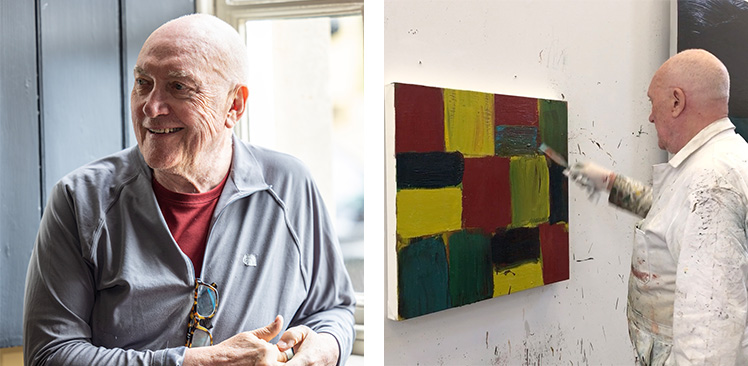
This image – reduced, simple, vulnerable – became the catalyst. Scully began attending evening classes at the Central School of Art, immersing himself in the world of painting. At first figurative, then increasingly abstract, drawn to the intensity of a Rothko, the clarity of a Mondrian, the wild expressiveness of a Pollock. Yet while many artists of the 60s and 70s pursued pure concept or cold minimalism, Scully searched for another language.
The 1960s art world was marked by a radical turn away from emotion. Conceptual art placed the idea above the object, minimalism reduced form to a detached vocabulary: squares, stripes, surfaces – all stripped of personal touch. Artists like Donald Judd or Dan Flavin championed a "depersonalized" art – cool, rational, distant. In this atmosphere, where the personal was almost considered a weakness, Scully made a quiet yet resolute statement: he took the language of minimalism – grids, lines, blocks – and infused it with feeling. With life. With memory.
His art is a response, even a resistance, to the emotional emptiness of his time. "I wanted to give abstract painting back the emotional and spiritual power it had lost," he said.
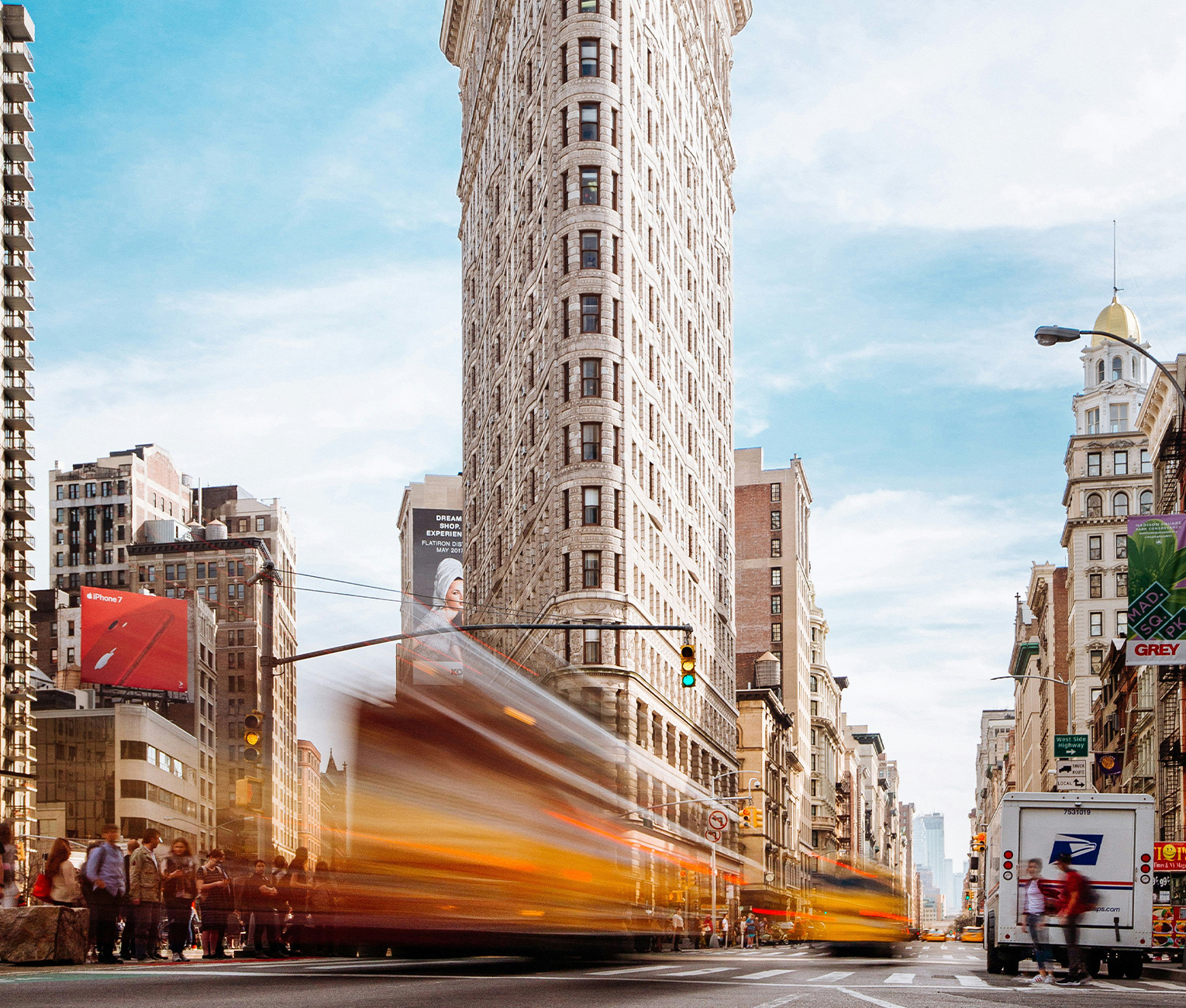
When he moved to New York in 1975, it was the architecture of the city that further shaped his visual language: the endless street grids, the steel and concrete frameworks, the light refracting in glass. But instead of idealizing these structures, Scully revealed their fractures, their imperfections. His lines are never perfect. They are soft, broken, overpainted, often surrounded by a gentle shimmer as if they are trying to elude the gaze. "Dirty geometry," Scully calls this way of painting – a term that captures his work perfectly: it is geometry, yes, but not sterile; it is shaped by human hands, marked by the process, by errors, by contradictions.
His paintings breathe. They are not cool, but warm. Not smooth, but rough. Within the layers of paint lie time, patience, repetition – a persistent struggle for expression.




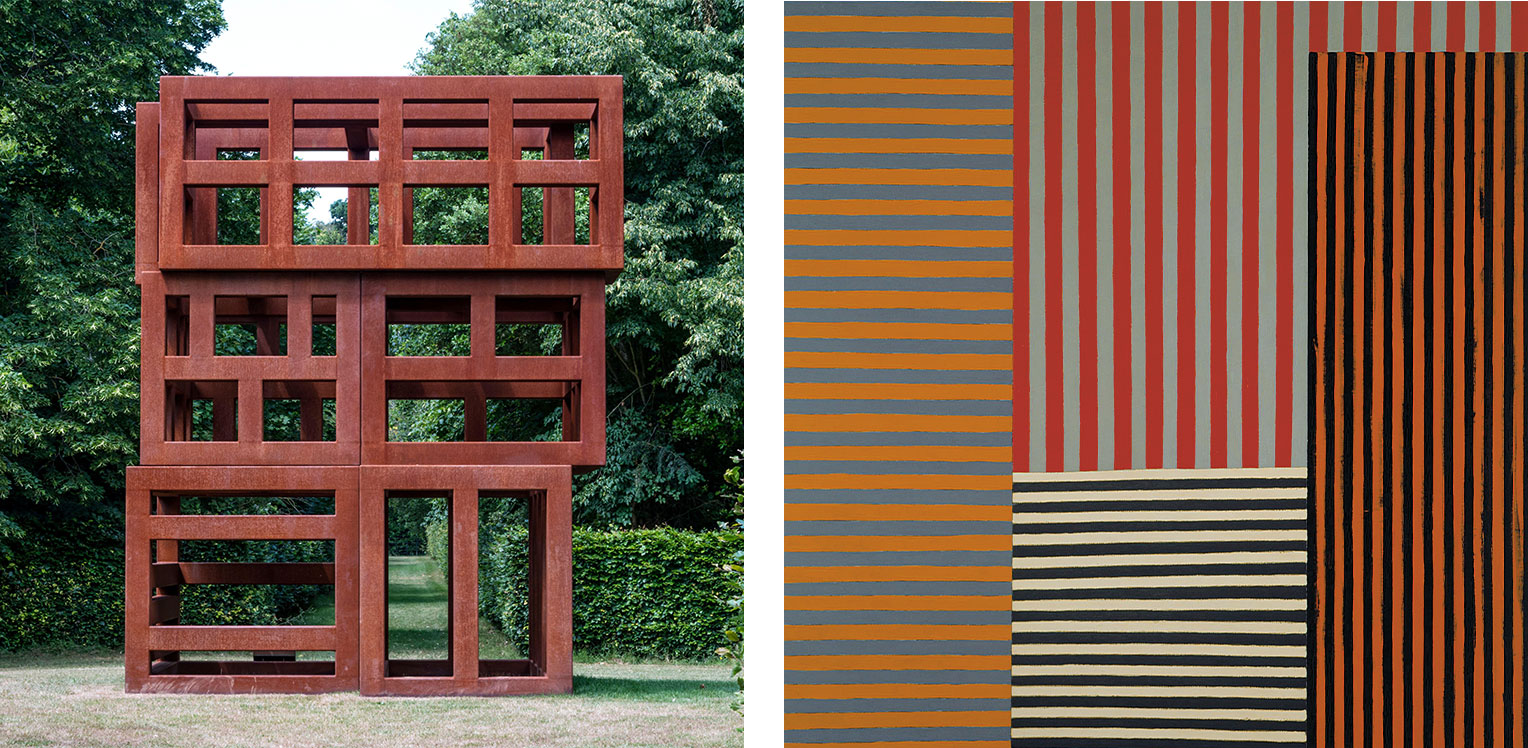
This struggle is visible in two of his major series: the Walls of Light and the Landlines. In Walls of Light, Scully layers bands of color, allowing underlying tones to shine through, as if the light itself were emanating from the painting. The surfaces appear like pulsating walls – massive, yet permeable.
They evoke ancient stonework, church walls, the patina of time. The Landlines, by contrast, resemble horizons, landscapes where sky meets earth, water meets light. Scully paints no objects, no scenes, and yet his works are full of the world: they speak of expanses, of light, of movement, of stillness. The "poetry of lines" in Scully's works mean that lines do not merely divide, but connect. They create rhythms, almost like musical beats, inscribed with emotion. The "humanity of abstraction" is exactly this: that behind every line lies a feeling, behind every block a memory, behind every grid a thought. His works urge us to see what is there not as an endpoint, but as an invitation – the beginning of a dialogue between the work and the viewer, between history and the present, between the rational and the emotional.
His art is now held in major museums around the world – MoMA, Tate, Centre Pompidou, Guggenheim. Yet Scully himself remains a seeker. A teacher. In Munich, where he taught at the Academy of Fine Arts, he passed on his knowledge, speaking with young artists about the necessity of perseverance, of questioning, of patience. "Talent alone is not enough," he said. "You have to understand the system, recognize your own possibilities – and persist."
His teaching was shaped by a profound respect for painting, by a conviction that art is more than a trend or a market value. It is a tool for understanding the world. And a space where the human reveals itself – in all its fragmentation, all its beauty, all its sorrow.